Boundary representation is the principal solid modelling method used in modern CAD/CAM systems. There have been a long series of developments on which currently available systems are based, full details of which are only partially known. Ian Stroud’s thorough coverage of these developments puts this technology in perspective and provides the most complete presentation of boundary representation solid modelling yet published.
Numen have designed Net Blow-up, a temporary installation in Yokohama, Japan.
Description
Net Blow up is a further development of the Net project both in means of construction and appearance. The object is inflated till the outer surface reaches adequate tension for stretching the nets connected on the inner side of the object. This construction excludes any use of additional structure.
The result is a soft object which deforms and mutates with every movement of its temporary habitants. The outer membrane acts both like a “soft box” diffuser of the outside light, or a projection screen in case of inner illumination of the installation.
InForm together with Pleysier Perkins have designed the California House, located in Brighton, a suburb of Melbourne, Australia.
Description
This modernist inspired architecture, with deep horizontal roof planes, extensive glazing and emphasis on outdoor living is perfectly suited to the Australian lifestyle and climate.
The California house maximises the potential of its corner site with all living spaces orientated towards north facing gardens. The upper floor accommodates a master domain and three other bedrooms, separated by the stair well.
Stained western red cedar cladding contrasts with white fascias, tiled fireplaces and silver travertine that flows throughout the ground floor and external terrace.
Park + Associates have designed a house in Singapore named Mimosa Road.
Description
Mimosa Road was first introduced as a reconstruction further the idea developed into a new erection residential project that unfolds more of its potential to suit both the client’s demands and the architect’s ideas.
Park + Associates aimed to capture modern design through clean straight lines and massive forms compensated by meticulous and creative selection of materials to keep a warm rustic touch to the feel of the house. One from these materials is burnt orange brick that reconnects the history of the original house prominently having exposed bricks all throughout.
Design modelling has benefited from computation but in most projects to date there is still a strong division between computational design and simulation leading up to construction and the completed building that is cut off from the computational design modelling. The Design Modelling Symposium Berlin 2013 would like to challenge the participants to reflect on the possibility of computational systems that bridge design phase and occupancy of buildings. This rethinking of the designed artifact beyond its physical has had profound effects on other industries already. How does it affect architecture and engineering? At the scale of engineering and building systems new perspectives may open up by engaging built form as a continuous prototype, which can track and respond during use and serve as a real world implementation of its design model. This has been tried many times from intelligent façades to smart homes and networked grids but much of it was only technology driven and not approached from a more holistic design perspective.
In today’s fashion industry, the traditional skills of forecasting, cutting, sewing and drafting are no longer enough. Students must be able to transform their two-dimensional plans into computer-generated images. From Pencil to Pen Tool: Understanding Creating the Digital Fashion Image teaches Adobe PhotoShop CS and Illustrator CS techniques applicable to both fashion students entering the field and established fashion-industry professionals seeking to stay current with technology. This book includes technical instruction about sketching and image production, as well as practical advice about creating a computer-generated portfolio and entering the fashion marketplace. Instructor’s Guide available on request
Architects: 05 AM Arquitectura
Location: Carrer Manresa, Sant Vicenç de Castellet, Barcelona, Spain
Project Team: Joan Arnau Farràs, Carmen Muñoz Ramírez
Project Area: 1,335 sqm
Project Year: 2010
Photographs: José Hevia
Collaborators: Jordi Sánchez
Structures: Genescà Molist S.L.
Facilities: GEPRO engineering
Technical Architect: Antoni Ventura i Carles Valldeperas, AVIASAT. Dirección de Ejecución
Budget: Sergi Pérez y Anna Badias
Client: GISA
Owner: CATSALUT
Construction: Construcciones Cots i Claret S.L.
Project: September 2006 – February 2007
From the architect.The building fits into its immediate urban context, as it identifies the specificity of the pre-existing buildings on the site. It is adjusted around them with the goal of giving them new value.
The volume in relation to the street has two floors, a direct encounter with the sidewalk and vertical openings. Instead, the volumes facing the railway have a single story, are high on the ground and the openings are unified in a single horizontal strip.
The row of poplars and the old railway facilities warehouse define the exterior limits of the access.
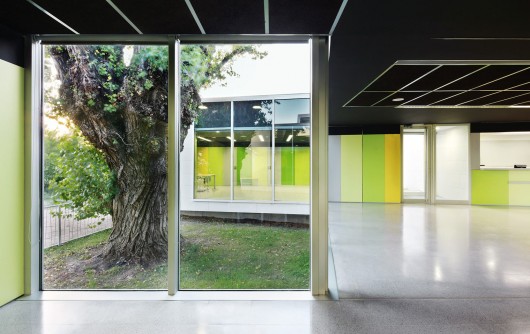
The lobby is strategically positioned in the center of the building, acting as a panoptic space that articulates and relates the different functional areas, as well as the views of the pre-existing exteriors.
At one end of the lobby, a courtyard surrounds the large poplar and allows us to separate, on its two other sides, the health education classroom and consultation area.
Consultation rooms are located on both sides of a waiting area lit naturally through two skylights oriented intentionally to frame the foliage of the poplars.
In the continuing care area, the waiting room has a double height and a window at the end that frames the old warehouse and the row of poplars at the access.
The answer to the site becomes a resource, an opportunity to add value to the correct functional design, characteristic of a primary care center.
After three months of in-depth analysis and public outreach, the U.S. Department of Housing & Urban Development (HUD) has shortlisted 10 design “opportunities” for the third and final round of Rebuild by Design. The design competition, focused on making New York’s Sandy-effected regions more resilient, sustainable, and livable, will now have the final project teams collaborate with local and regional stakeholders in developing their projects over the next five months. The goal is to arrive at projects that are implementable and fundable, leveraging the variety of federal recovery investments being made in the region.
OMA, BIG and WXY are just a few practices involved in the final round. Read on to review a glimpse of each shortlisted proposal.
The Final Shortlist:
Coastal Commercial Resiliency Financing Project Team: HR&A Advisors, Inc. with Cooper, Robertson & Partners Location: Regional
The HR&A team is working with businesses, merchants associations, and local government in up to three vulnerable areas in New York City and on the New Jersey shore to create a replicable financial tool to enable implementation of temporary and long-term physical and operational interventions, protecting critical local businesses from future extreme weather events and climate change.
Resilience + The Beach
Project Team: Sasaki, Rutgers, Arup
Location: New Jersey
Sasaki’s vision for the Jersey Shore builds upon one of its most valuable assets – the beach. Three typologies define the beach culturally, economically and ecologically: the Barrier Island, Headlands, and Inland Bay. Within this framework, the design opportunity rethinks iconic elements of the human experience of the shore – the pier, the boardwalk, and the marina – to integrate ecological function and help the region adapt in the face of sea level rise.
Designing with Nature for the Future of the Mid-Atlantic Coast
Project Team: WXY, West 8
Location: Regional
A paradigm shift in coastal planning is essential at the regional level. A cost-benefit analysis reveals the potential for large scale storm mitigation measures to play a significant role in coastal management. The design opportunity here is in the governance, insurance, and communications mechanisms that would aid in the resiliency of this vulnerable territory.
New Medowlands: Productive City + Regional Park
Project Team: MIT CAU, ZUS, Urbanisten
Location: New Jersey
Our project includes a gradual conversion of substantial parts of the Meadowlands into a regional landscape infrastructural park that protects the edges from floods and rebuilds biodiversity lost over the past century; absorbs water; and hosts recreational, civic programs. Along the edges, a mix of new residential density and other uses could take advantage of the park as a civic amenity.
Living with the Bay: Resiliency-Building Options for Nassau County’s South Shore
Project Team: Interboro Team
Location: New York
This project presents a collection of resiliency-building initiatives for communities on Nassau County’s South Shore. While the safety of residents during future extreme weather events is the main goal of these initiatives, each seeks to also enhance the quality of everyday life in non-emergency times. Taken as a whole, the initiatives present a collection of relatively low-risk, “no regrets” propositions for the present that sow seeds for a more resilient future.
Resist, Delay, Store, Discharge: a comprehensive strategy for Hoboken
Project Team: OMA
Location: New Jersey
Hoboken is susceptible to both flash flood and storm surge. Our project capitalizes on a combination of political, ecological, and economic factors to create a comprehensive flood strategy – resist, delay, store, discharge – that both defends the entire city, and enables commercial, civic, and recreational amenities to take shape.
The BIG “U”
Project Team: BIG TEAM
Location: New York
The multivalent ‘U’ consists of multiple but linked design opportunities; each on different scales of time, size and investment; each local neighborhood tailoring its own set of programs, functions, and opportunities. Small, relatively simple projects maintain the resiliency investment momentum post-Sandy, while setting in motion the longer-term solutions that will be necessary in the future.
Living, Growing Breakwaters: Staten Island and Raritan Bay
Project Team: SCAPE / Landscape Architecture
Location: New York
Our layered strategy introduces protective breakwaters and interior tidal flats that can dissipate wave energy and slow the water, while rebuilding sustainable oyster populations within the Harbor. Working with locally impacted communities a range of alternative futures can be developed that are effective, resilient, and complimentary to the ongoing shoreline work of the area.
HUNTS POINT / LIFELINES
Project Team: PennDesign, OLIN
Location: New York
This Design Opportunity engages community to develop site-specific designs for integrated storm protection and green infrastructure that offers high quality social space, engages industrial property owners, and has components that can be manufactured locally and built cooperatively. The aim is to stake out the potential of hybrid port protection and ecology uses throughout the estuary.
The project will build the spaces and programs for the South End of Bridgeport to become more self-sufficient through public safety, education and job training, community activities, and a mix of commercial and housing functions fostering connections between people. The City’s proposed Green Collar Institute will become part of the neighborhood’s resilience, training people for green industrial processes, building retrofitting, construction disassembly and salvage, landscaping, environmental remediation, renewable energy, and materials upcycling research and development.
From the architect.The design of this house arises from previous research and understanding of the regional architecture of the Ecuadorian highlands, and how it engages with a modern system through understanding the place, tectonics and space of each, creating a tension between the two systems.
First are the traditional architectural and spatial elements, such as the courtyard, the wall, porch and slope. At the same time, the open plan and the continuous space are modernist concepts contrasted with the elements previously mentioned. The material palette includes local stone, wood and tile as local or endemic materials, and exposed concrete, steel and glass as modern materials. This mix not only expresses a formal idea, but also a structural and constructive idea that reinforces the argument.
In an area of approximately 2 hectares with a steep slope, the house is implanted in the highest part of the site, with a privileged view. In plan, the house is designed linearly, taking advantage of the views from every room. The design in section becomes important, access is from the upper level of the site to the social area, kitchen and terrace. The most private areas and bedrooms are on the lower floor.
The house is stratified into two zones: the stone base and glass box on top. The base is a stone bearing wall, where private areas are distributed. This base, true to its characteristics, is the support of the house on the ground, and contains the excavated soil for its settlement. It comes into view in full from certain viewpoints, while from others it is half-buried and seems to arise. At the back and at the entrance of the house, a large cut in the ground generates a submerged courtyard which serves mainly to illuminate and ventilate the bedroom areas on the ground floor. At the same time, it becomes one of the most important areas of reference of the house. It is contained by an exposed concrete wall, contrasting with the stone wall, thus creating tensions between the two systems.
The arrival to the house is through a steel and glass bridge that intersects with the stone wall, and opens the space to a large steel and glass nave that contains the social areas of the house on the upper floor. On this nave rests a traditional mud tile roof.
Finally, the finishes of the house are simple materials like concrete and wood on floors, concrete walls, wood deck, etc.. The lightness of the glass top volume is even more evident at night when artificial light exposes its permeability and the great nave of the roof, which is juxtaposed with the monolithic volume of the base on which it rests.
Architects: Clive Wilkinson Architects
Location: Irvine, CA, USA
Architect In Charge: Clive Wilkinson, Sam Farhang, Sasha Shumyatsky, Matt Moran, Chester Nielsen, Andrea Schoening, Mitsuhiro Komatsu, Annie Ritz, Meredith McDaniel
Area: 82,000 sqm
Year: 2012
Photographs: Benny Chan
Mechanical And Plumbing Engineers: TK1SC
Electrical Engineers: OMB Electrical Engineers, Inc
Structural Engineers: Englekirk Structural Engineers
Landscape Architect: Melendrez
Civil Engineers: Ware Malcomb
General Contractor: Howard Building Corporation
From the architect. The leaders of the motocross apparel company, Fox Head, Inc. approached us in November 2011, with the goal of relocating their headquarters from Morgan Hill, in Northern California, to Irvine, California. They wanted a space that would inspire their staff and encouraged CWa to challenge preconceptions about how an office space can work and how this warehouse shell could become a cutting edge creative house.
The industrial warehouse on Armstrong Avenue in Irvine offered an opportunity of consolidating the company in one open, creative environment. The design solution for the 82,000 sq. ft. space evolved from the desire to create a functional yet playful environment that befits the Fox image. Equally significant was the company’s desire for an open, flexible and collaborative work environment for its employees.
Traditional urban planning concepts were utilized to provide the architectural frame to foster a community centered around place, interaction and innovation. A Main Street concept, individual task-oriented neighborhoods, park-like landscape elements and circulation-oriented ‘facades’ were each enlisted to create a community unique to the company’s culture. The various departments were organized on either side of the warehouse connected through a ‘Main Street’ bisecting the ground floor. The need to articulate the ‘Main Street’ led to the adoption of diverse interior building frontages emphasizing the varied functions. Fox’s operational needs were met through incorporation of open offices, workstation systems tailored to departmental needs and accompanying support spaces, such as sewing room, photo studio and tech-room.
On the exterior, a sculptural addition was proposed to accommodate Fox’s main entrance and provide an identifying landmark. From the main entrance, a wide street leads you through the single story reception area, defined by a red slatted ceiling, into the ‘Main Street.’ Here product showrooms define the boundary of the ‘Main Street’ terminating at the lounge/cafeteria zone with its 18-foot high glazed storefront opening to the outdoor recreation area. Here informal meeting areas are housed on the ‘roofs’ of the ‘Main Street’ structures and a raised boardroom offers an unprecedented view of the ‘Main Street’ and the creative warehouse area. Existing and new infrastructure are exposed and coordinated to enhance the architecture, while thewarm palette of reds, oranges and yellows reference the original brand colors of Moto-X Fox while differentiating the ‘monuments’ in the city from the muted background.
Fox’s brand represents a diverse set of apparel, equipment, and lifestyle products. In order to celebrate this diversity, the architecture was enlisted to emphasize the different teams of designers, engineers and marketing professionals behind the company image. Each area of the design boasts a uniquely identifiable character. The resulting ‘city’ is a reflection of the company’s character: an open and creative workplace that fosters interaction between varied groups of specialists.
The exterior grounds offered an extension to the workplace and gave Fox the opportunity to embrace the active culture which it represents. A scheme was developed with a raised garden area emanating from the warehouse, enclosed by hedges and shade trees. Outside the clubhouse, loose furniture under trees encourages people to meet, work and relax; while a bike track becomes a highly visible extension of the company.
To realize the project within a tight timeframe, the project team took a highly collaborative approach, enlisting early input from the contractor in order to streamline the design and construction process. The project was taken from conception to permitting within 4 months, and constructed on a fast-track schedule over 7 months. The resulting efficiency of delivery ensured the client significant costs-savings without sacrificing quality of the finished product.