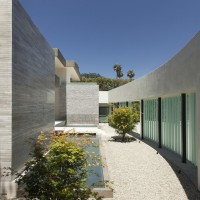
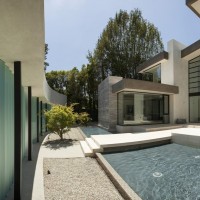
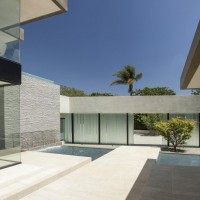
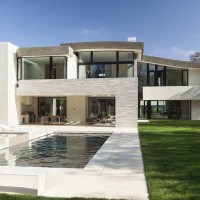
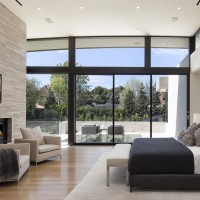
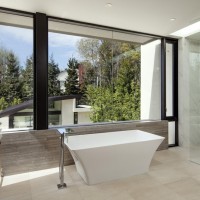
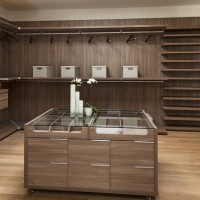
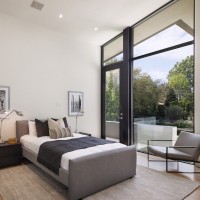
White Wolf Hotel is a series of buildings intimately related with the rich surrounding natural environment. The built architecture is a realization of the holistic aspirations of the client. The built architecture objects, profoundly integrated in the natural context, provide holistic and spiritual experiences of calm, intimacy, meditation, and retreat. The objective was, from the starting point, holistic. The challenge was to create a place that praises nature, a special place dedicated to the body and spirit, accordingly to the clients’ alternative ways of living, and even the perception of life itself. It is a place where the visitor is involved in positive thinking and embraces related humanistic values, far away from the stress paradigms of contemporary life. Instead of a single construction condensing the entire program, the adopted strategy aimed to spread the facilities through separated buildings along the site, adapting itself to the existing natural conditions, respecting and enhancing its values. The shape of the architecture, achieved by basic, clear, and direct geometric forms, aimed to provide a natural, non-aggressive sensation and a natural visual relation between the user and the buildings. The buildings are meant to be neutral in the landscape, in a gesture that avoids an …
A visually sensational study of the rose window both in its own right and as a central feature of Gothic architecture.
Painton Cowen has dedicated his life to the study of rose windows. Here he presents the world’s best-known rose windows in over 300 new photographs and line drawings—Paris (Notre Dame), Chartres, Reims, Strasbourg, Cologne, Florence, Siena, Palma de Mallorca, Santa Maria del Mar, and New York’s St. John the Divine, as well as many lesser-known, but no less astonishing, examples.
Every aspect of the rose window is covered, including its possible origins in the south of Europe, its flowering in thirteenth-century France, the diffusion of styles across Europe, and modern reinterpretations, as well as the powerful geometry behind the designs and the meanings specific to individual examples. Perennial favorites such as the windows at Chartres are dissected and discussed in detail.
This book provides unique insights into the development and organization of the rose window and its central position in Gothic architecture through a lucid, illuminating text and carefully selected comparative material that covers the wealth of Gothic creative activity. It also explores the greater meaning of the rose window through numerology, scholasticism, and the concept of heavenly order. 350 illustrations, 300 in color.
Contractor: Wates Construction
Structural: Arup
Cost Consultant: Davis Langdon
Landscape Architect: Grontmij
Acoustic Engineer: AEC
From the architect. Design
The contemporary five-storey building is designed around a central atrium which brings in natural light, connects spaces together, and provides passive ventilation. The highly efficient plan increases the net-to-gross floor area to 86%. Adaptability of space is fundamental, ensuring easy modification to suit future generations’ working practices.
The ground floor of the building provides public service facilities, including the One-Stop-Shop, plus support facilities for the building, whilst upper floors provide office space for staff. The One-Stop-Shop and Council Chamber are located at the front of the building, overlooking the new square and allowing passers-by to observe democracy in action.
Office floor plates have been designed to incorporate an open plan formation which facilitates flexible sub-division of office space, allowing for open plan desk arrangements, maximising the usable life of the building and reducing the overall running costs for the Council. The use of quality building materials was a necessity, whilst promoting sustainability and low-energy principles.
Appearance
The council chamber façade is clad with an abstract pattern of coloured, glazed terracotta baguettes. Nearly 3,200 tiles in 12 different colours have been installed, creating a focal point and a unique identity. Terracotta’s longevity and sustainability make it an ideal choice for the building, manufactured from natural robust materials, it is low maintenance and extremely weatherproof.
A high-quality concrete structural frame has been left exposed inside the building, providing thermal mass, fire and acoustic benefits to the scheme. The finish avoids the need to plasterboard, saving on even more costs. Timber panelling has been used to create a warm visual contrast to the concrete and also acts as an acoustic absorber soaking up any noise generated in the atrium.
Sustainability
The scheme takes a holistic view of sustainable design, integrating environmental, structural and architectural elements to create a low energy solution, achieving a BREEAM Excellent rating.
Passive, rather than active measures have been utilized to ensure lower running costs and significantly less maintenance. It is expected that these measures will achieve huge savings for the council. The central atrium maximises natural ventilation throughout the building, significantly reducing air handling. Via the elevations, the atrium also maximises natural daylight, reducing the need for artificial lighting.
The use of a green roof enables sustainable drainage and provides a natural habitat for wildlife. Rainwater harvesting will enable the re-use of any unabsorbed water for WC flushing. A selection of materials were chosen from the BRE Green Guide, minimising environmental impact.
Value for Money
Staircases, M&E plant and vertical service risers were prefabricated offsite and craned into place, reducing the overall cost and programme time, whilst improving the quality of these components.
With construction costs within budget, the new civic offices are without doubt a ‘model of modesty’, maintaining the highest quality finishes whilst ensuring that the Council’s operational costs remain streamlined beyond project completion.
Whether a gently rolling hill or rocky steep terrain, a sloped site provides a compelling setting on which to build a house that contrasts with ordinary flat lots. Unlike horizontal typography, where every structure lies at the same elevation, a slope allows for the rooflines of houses to stagger down the site, providing more expansive, uninterrupted viewpoints. But while a steep site comes with the advantage of panoramic vistas, it also presents challenges to architects. Since houses usually sit perpendicular to the site, architects must design the foundation to properly mitigate the angle of incline. The steeper the angle, the taller the foundation — which can sometimes lead to houses that look as if they’re propped up on a pedestal. Alternatively, the lower levels of houses can be dug into the land, which leaves half of the living spaces sitting below ground. Today, we see architects coming up with innovative solutions to building on slopes — such as designing structures that physically mimic the angle of incline. The following designs for sloped sites are anything but slippery: 8008 by Hiroyuki Arima, Fukuoka, Japan On a steep slope in Fukuoka, Japan, the 8008 house is composed of …
Interior Design: NC Design & Architecture
Design Team: Nelson Chow, Chris Lam, Yazh Yip, Pierre Wu
Furniture Designer: Bridge Lam
Contractor: Kin Wah Decoration Limited
Custom Lighting Supplier: Ricardo Lighting Limited
From the architect. Prominently located on the 10th floor of the Times Square Shopping Center in Causeway Bay, Hong Kong, Pak Loh Chiu Chow Restaurant by NCDA is the latest addition to the multi-outpost Family owned Restaurant Group. Established in 1967, Pak Loh is locally renowned for its traditional Chiu Chow cuisine, which originates from the coastal region of Guangdong Province. To cater to the evolving tastes of the newest generation of Hong Kong diners, Pak Loh’s mission is to bring new elements to popular conventional dishes using innovative techniques and premium seasonal ingredients. As a design strategy, NCDA interpreted the mission statement and created a 6000 SF restaurant that represents the convergence of the old and the new through a synthesis of vintage references and streamlined modern details.
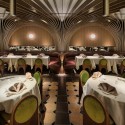
Arriving at the restaurant, diners pass through a curved passageway comprised of faceted brass vertical screens which leads to the main wood covered dining room. Placed on either side of the entrance, two curvilinear VIP rooms allow for a gradual passage from the bustling mall into the cocoon like wood interior of the main dining space. The compressed entryway accentuates the generous volume of the main dining room beyond, and in turn the transition provides a calm yet discreet experience for the patrons as they enter and leave the restaurant.
Dominating the main dining room, the vaulted walnut veneer ceiling structure references the spirit of 1960’s Hong Kong in a futuristic cutting-edge manner. The ribbed CNC milled ceiling structure consists of 20 half arches, which are rotated and repeated at angular increments to cover the entire ceiling. The ceiling geometry results in a cost effective and relatively simple installation that yields a unique and complex form. The wood clad structure offers good sound absorption properties which helps to reduce noise level in an otherwise loud space. Bespoke wall sconces and suspended light fixtures are being placed strategically to create a rythmical pattern that further highlights the delicate framework of the ribbed structure.
While the vaulted structure of the main dining room appears airy and larger than life, attention to small details and materials offer a comfortable and intimate scale at each of the dining zones. For instance, custom upholstered burgundy leather banquettes with horizontal mirrors and 60’s geometric print wallpaper define individual table groupings. Furthermore, custom olive green velour chairs with curved legs are design to echo the vaulted ceiling and to break the scale of the space down to more intimate components.
Efficiently located at the back of the restaurant, the bathroom is divided into male and female halves using a large central communal sink. Custom backlit male and female WC indicators are placed above each door in the manner of an aircraft installation, and leads the patrons to the corresponding toilet compartment where each one is cladded with a distinct color tiles.
In the design of Pak Loh, NCDA sought to avoid any direct links to the Chinese vernacular, while mixing modern and classic materials to create a comfortable and refined dining space that respects the 60’s Hong Kong manner of dining. Pah Lok Chiu Chow Restaurant showcases a holistic approach to restaurant design, seamlessly integrating the interior design, furniture, lighting fixtures, graphics, and staff uniforms. By defining an aesthetic from the mood and lighting of a space right down to its detailed ceiling construction, the end result is a visually striking yet highly functional contemporary restaurant.
Originally published in 1976, this book introduced a series of mathematical models of urban phenomena relevant to scientists and planners attempting to understand and predict the form of cities and regions. Dr Batty organises the book around the main theme of designing and using such models in practical situations and develops a family of static and dynamic models dealing with the location of land use and economic activities. He describes the models both as urban theories and as computer algorithms, and thoroughly explores the process of calibrating or ‘tuning’ the models to reflect reality. Problems concerning the definition of the spatial systems to which these models refer are examined, as are other practical difficulties such as data organisation. The quasi-experimental approach which characterises this style of computer model-building extends to using the models in conditional prediction and Dr Batty discusses their role in the planning process, with their use in testing the impact of public policies on existing conditions.
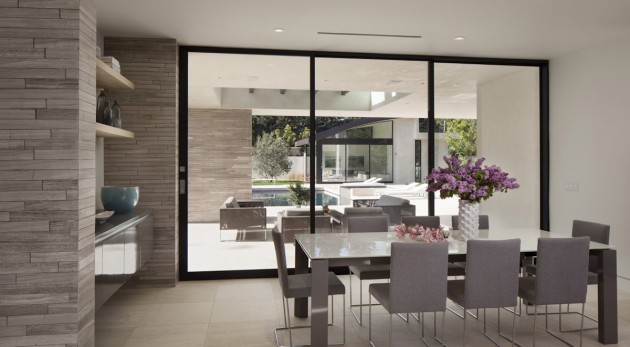
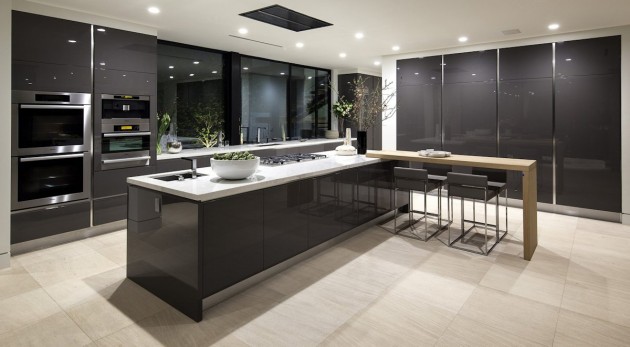
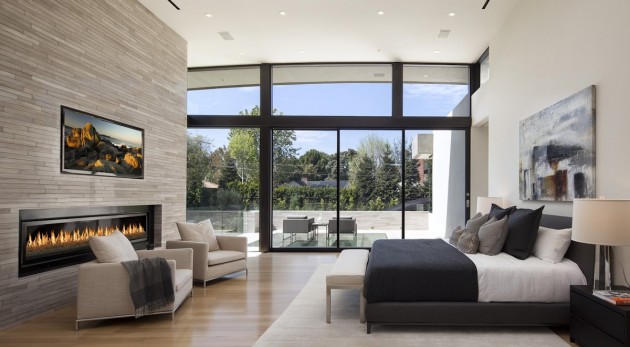
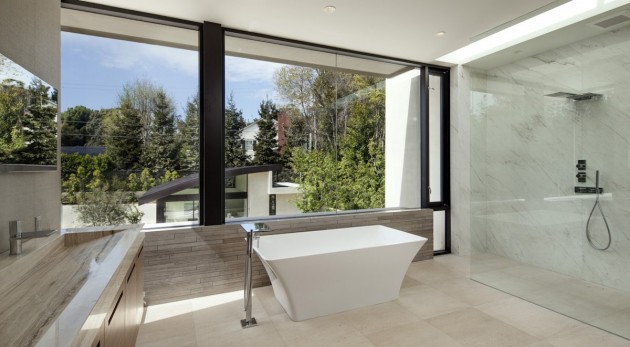
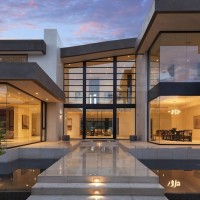
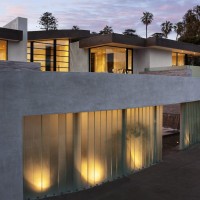
McClean Design completed the San Vicente House in California.
Project description
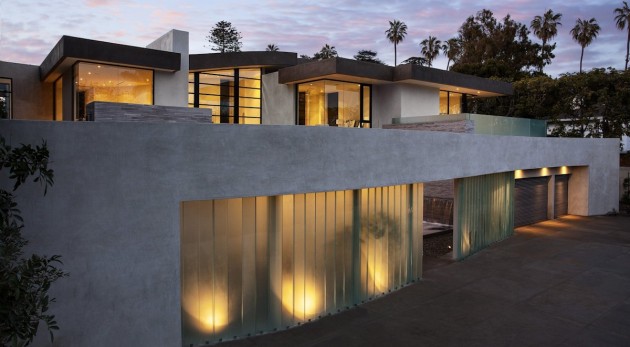
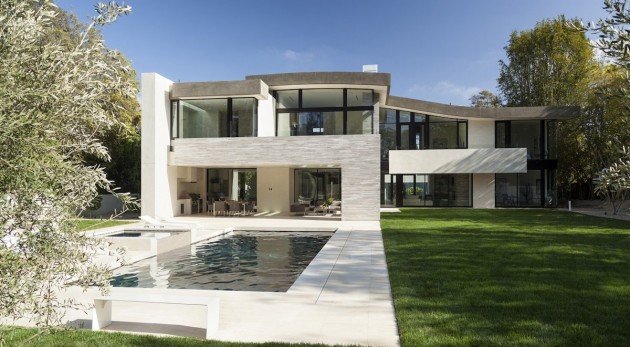
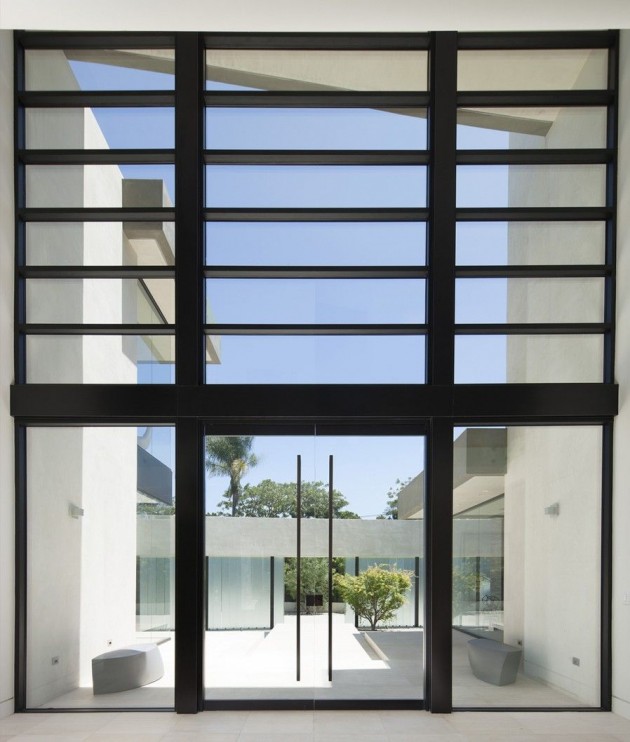
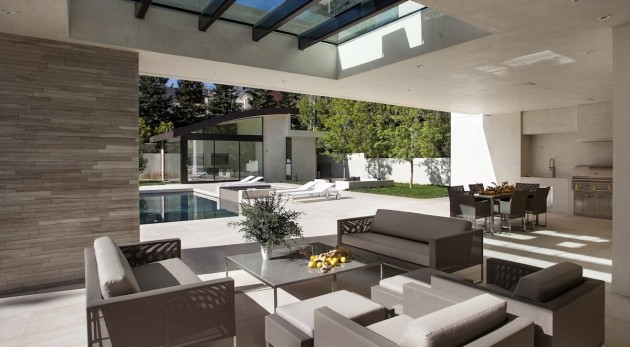
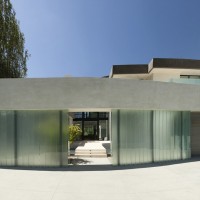
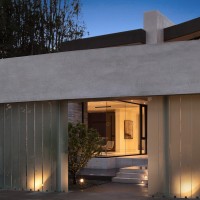
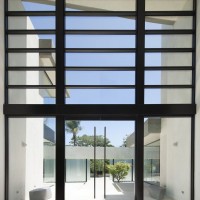
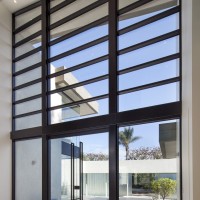
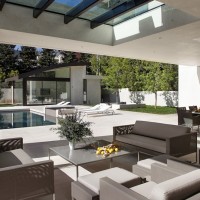
Designed for a family with three small girls this house needed to respond to the busy street it is located on. We came up with a sequence of entry which uses several devices to separate the occupants from the noise beyond. The drive court is screened from the street by high gates and tall landscaped elements. This area connects to an inner courtyard through a curving glass screen designed to allow the light to pass through but shield from the cars and noise. The courtyard contains a waterfall and an infinity edge pool both of which help to instill a feeling of calm as you approach the house. Our hope is by the time you enter into the two story entry hall you have left the rest of the world behind. The L shaped plan of the house maximizes the expansive back yard while further screening potential noise such that the rear yard is extremely quiet and peaceful. The garden also contains a pool and guest house.
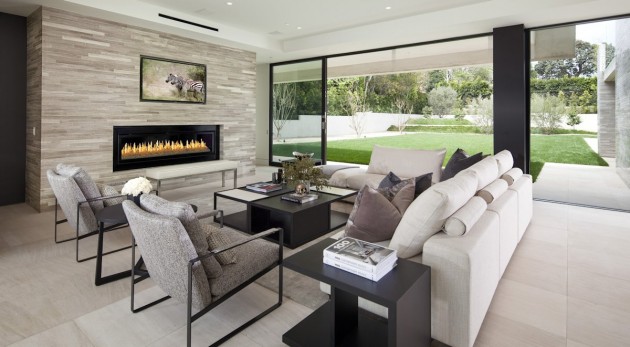
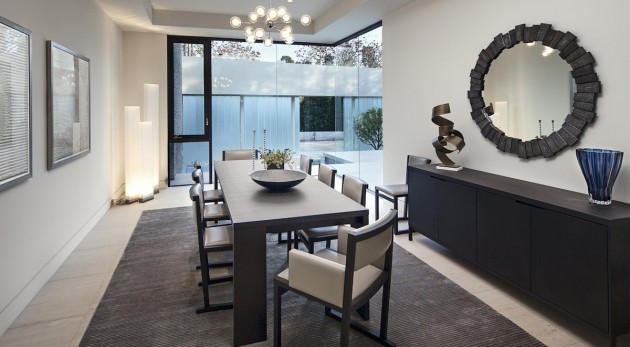
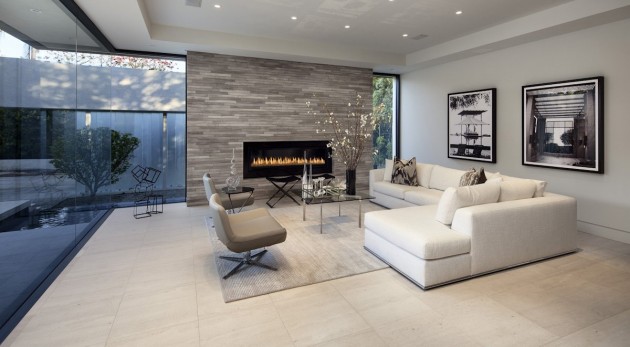
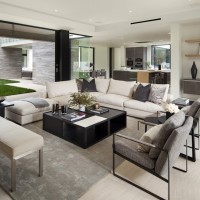
The house consists of master plus four bedrooms on the upper level with a family room, art room and gym. The lower level has formal living and dining rooms, family room, media and office plus associated secondary spaces. The house is finished in cool grey and cream limestone with light plaster and paint tones and bronze metal accents.
From the architect. This project was completed for a developer/home builder at the intersection between Coleraine Street and a laneway in Montreal’s Point St-Charles neighborhood.
The basic program for this project required 2 row-homes on an 8.7m wide lot. After accounting for setbacks and other constraints, traditional planning approaches would have resulted in 2 long narrow houses, which severely lacked natural light. Our solution was to intertwine both units in a zigzag fashion, maximizing on natural light, and creating dynamic angular spaces. The two units intersect at the top floor to create an intimate space for a master bedroom, an office, and a terrace in each unit. This design was reinforced by the site’s footprint, which has a 75-degree angle at the intersection between the street and the laneway and further inspired the creation of angular forms and oblique perspective lines within the interior.
The building is composed of a brick base, which relates to the neighborhoods vernacular, and is topped with a contemporary angular volume clad in steel that cantilevers over the base. The minimalist interiors each have a double height space with a suspended wood platform. The stair, wrapped in a black expanded-steel handrail, ascends to the master bedroom where a reading nook bathes in natural sunlight.
The client requested a design for their home that would melt into the surrounding paddy landscape and also provide a safe, stable living environment for generations to come. The architect responded with a plan that incorporates multiple courtyards, ensuring the privacy necessary for an open lifestyle, even if homes are built on surrounding lots in the future. If two generations with different schedules eventually share the home, the courtyards will also provide a comfortable degree of distance between the living spaces occupied by various members of the household. Photographer: Kaori Ichikawa
With the increasing sophistication of CAD and other design software, there is now a wide array of means for both designing and fabricating architecture and its components. The proliferation of advanced modeling software and hardware has enabled architects and students to conceive and create designs that would be very difficult to do using more traditional methods. This book focuses on the inspiring possibilities for architecture that can be achieved with all the different technologies and techniques available for making complete designs or their components.