Modelling High-level Cognitive Processes

This book is a practical guide to building computational models of high-level cognitive processes and systems. High-level processes are those central cognitive processes involved in thinking, reasoning, planning, and so on. These processes appear to share representational and processing requirements, and it is for this reason that they are considered together in this text.

The book is divided into three parts. Part I considers foundational and background issues. Part II provides a series of case studies spanning a range of cognitive domains. Part III reflects upon issues raised by the case studies. Teachers of cognitive modeling may use material from Part I to structure lectures and practical sessions, with chapters in Part II forming the basis of in-depth student projects.

All models discussed in this book are developed within the COGENT environments. COGENT provides a graphical interface in which models may be sketched as “box and arrow” diagrams and is both a useful teaching tool and a productive research tool. As such, this book is designed to be of use to both students of cognitive modeling and active researchers. For students, the book provides essential background material plus an extensive set of example models, exercises and project material. Researchers of both symbolic and connectionist persuasions will find the book of interest for its approach to cognitive modeling, which emphasizes methodological issues. They will also find that the COGENT environment itself has much to offer.

[ccw-atrib-link]

Cisura House / Manuel Cucurell + Sebastián Virasoro

Architects: Manuel Cucurell, Sebastián Virasoro
Location: Roldán, Santa Fe Province,
Project Team: Guillermina Borgognone, Ciro Rádice, Florencia Rinaldi, Germán Rodriguez.
Construction: Gustavo Farias
Exterior Furniture: Silvestre Borgatello-Estudio Loess
Project Area: 139.0 m2
Project Year: 2013
Photography: Gustavo Frittegotto, Manuel Cucurell

From the architect. This project is located in an area of the emerging farm pampa in a process of transformation, product of the economic growth in Argentina in recent years and the illusion of leaving the chaos of the city.

There, a new urban development seems to replicate a predominant scheme of soil use and productivity: an imperative of rationality of loads and maximum benefits in the yield of the land.

These are developments that have displaced crops leading to neighborhoods without public space. There are no sidewalks with trees and shadows, only internal roads and minimal services. Paradoxically, these areas in the Argentine plains seem to edit a colonization of the pampa. More than a century ago, through the railway stations, the immensity of the plains were inhabited. In these colonies, the new settlers had to face the empty immensity, the fear of darkness, and the distance at night.

This scene is repeated today, but not long from now, these areas will end up consolidated, setting up a new event: the privacy of the inhabitants will be invaded by the inability to build party walls and by the density with which these neighborhoods are designed.

Cisura House

How to conceive a spatial structure that beyond housing the activities required, is able to respond to the contingencies of a scenario and people in transition? A structure that can meet the need for protection and shelter at first, and over time, transmute into privacy.

“In response to these concerns, introspection is the argument that guides and sets the search criteria.” The fissure, both concept and action, is a gesture that gives the project its expressive character, bringing in light and determining different spatialities where inside and outside are expressed as ambiguous and indistinct concepts.

Introspective and anonymous atmospheric experiences are possible by designing small courtyards within the interior spatiality, which opens even the possibility of experiencing showering under a summer rain.

The house is therefore conceived as an open system, an ordered set of elements and associated factors that interact with each other. Each of the parts has a specific function, which integrated and dependent on each other keep the whole operating.

The coherence of the project as unit arises from the symbiosis between the factors of the system, those of the environment in transition, and those of the complex web of emotions that belong to all of human creation.

Casa Cisura / Manuel Cucurell + Sebastián Virasoro © Gustavo Frittegotto
Casa Cisura / Manuel Cucurell + Sebastián Virasoro © Manuel Cucurell
Casa Cisura / Manuel Cucurell + Sebastián Virasoro © Gustavo Frittegotto
Casa Cisura / Manuel Cucurell + Sebastián Virasoro © Manuel Cucurell
Casa Cisura / Manuel Cucurell + Sebastián Virasoro © Gustavo Frittegotto
Casa Cisura / Manuel Cucurell + Sebastián Virasoro © Manuel Cucurell
Casa Cisura / Manuel Cucurell + Sebastián Virasoro © Gustavo Frittegotto
Casa Cisura / Manuel Cucurell + Sebastián Virasoro © Manuel Cucurell
Casa Cisura / Manuel Cucurell + Sebastián Virasoro © Gustavo Frittegotto
Casa Cisura / Manuel Cucurell + Sebastián Virasoro Elevations
Casa Cisura / Manuel Cucurell + Sebastián Virasoro Plans
Casa Cisura / Manuel Cucurell + Sebastián Virasoro Details

[ccw-atrib-link]

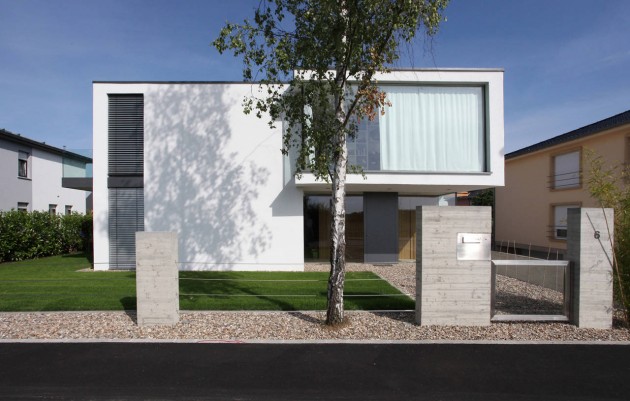
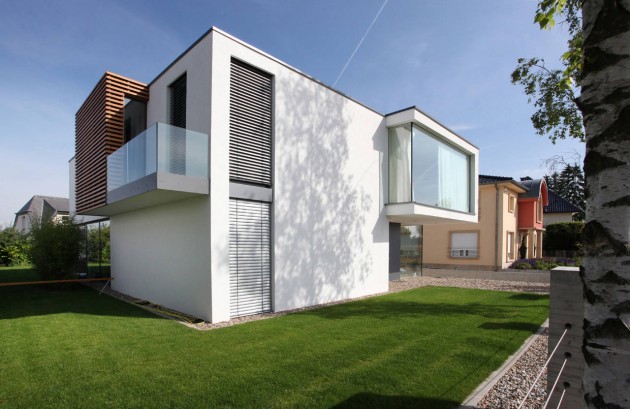
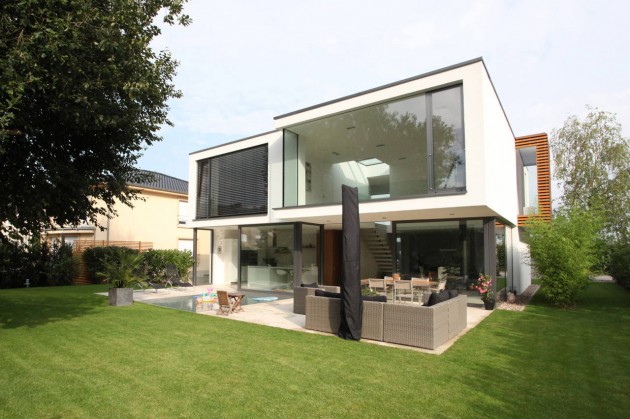
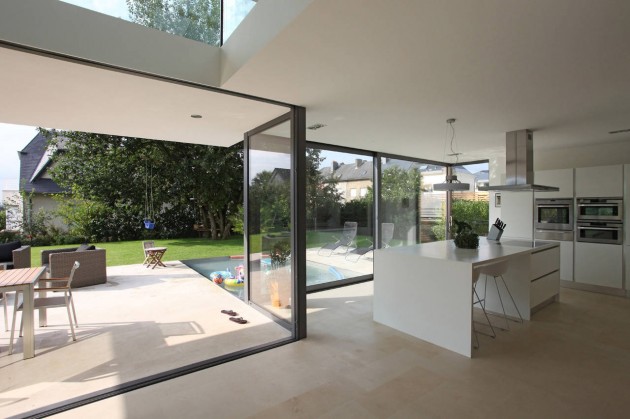
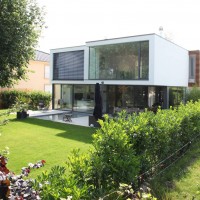
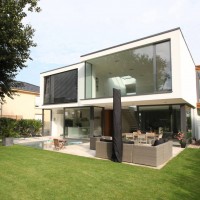
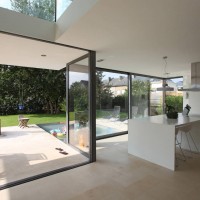
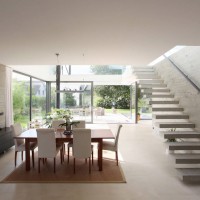
House THE by n-lab Architects

n-lab Architects designed this house for a family in Luxembourg.

the_090114_02

the_090114_03

the_090114_08

the_090114_09

the_090114_010

the_090114_011

the_090114_012

Description from n-lab Architects:

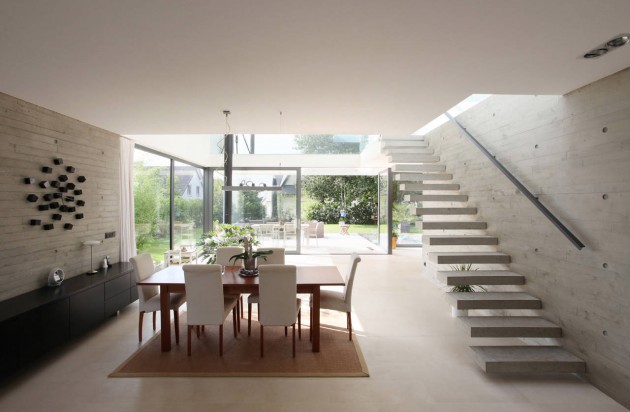
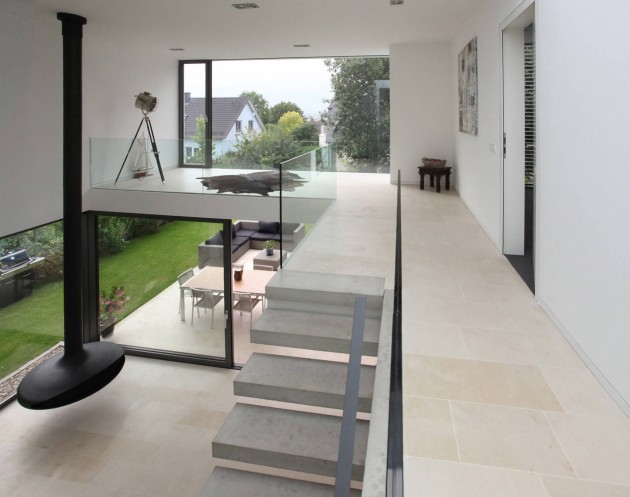
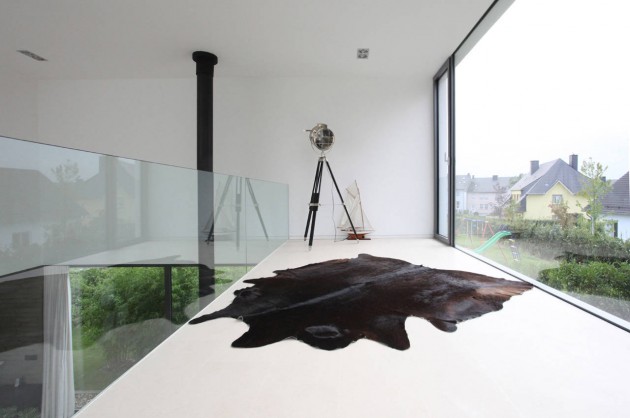
The clearly defined volumes play with the concepts of heaviness and lightness. A walk around the single-family house reveals firmly anchored volumes and floating bodies creating large overhangs. The four facades were treated with regard to local conditions. The few openings to neighboring buildings are partially covered in wooden slats in order to filter the views from and to the most private areas. The largest opening is on the garden side, where the entire first floor is raised off the ground.

the_090114_01
the_090114_02
the_090114_03
the_090114_05
the_090114_06
the_090114_07
the_090114_08
the_090114_09
the_090114_010
the_090114_011
the_090114_012
the_090114_013
the_090114_014
the_090114_015
the_090114_016

Architecture by n-lab Architects

.

[ccw-atrib-link]

361° Conference 2014: Architecture and Identity

The 361° Conference, an initiative by Indian Architect & Builder to create a relevant platform for dialogue on architecture in India, will take place on February 19th to the 21st in Mumbai. This year’s edition, based on the theme of “Architecture and Identity,” will include renowned speakers, including Steven Holl and Dr. B V Doshi. More details, after the break…

Conference Description

One of the oldest design forums in India, the 361° Conference is an initiative by Indian Architect & Builder (IA&B) to inspire a thought-exchange programme on relevant ideas in architecture and critical concerns of the discipline and thus, create a relevant and serious platform for dialogue on architecture in India.

The seventh edition of the 361° Conference is scheduled for the 19th-21st February 2014 at the Nehru Centre, Mumbai. This edition will deliberate on the theme ‘Architecture and Identity’. In the context of architecture, as we move further in the 21st century, we find incredibly diverse and individual trajectories of academia, practice and building. Within this diversity, we find a consistent struggle by individuals and groups to anchor ideas to their appropriate roots. Introspective and reflective in its essence, this search for the origins or the fundamentals is critical in contemporary architecture as the search is what determines the trajectory. This Conference will focus on the people and practices that have an investment in the idea of identity; whose work takes a critical position on this issue.

Speakers

Dr B V Doshi, India; Steven Holl, William J R Curtis, France; Aniket Bhagwat, India; SPASM, India; Channa Daswatte, Sri Lanka; Dominic Sansoni, Sri Lanka; Minakshi Jain, India; Rick Joy, USA; Hector Fernandez Elorza, Lars Müller, Switzerland; and Kashef Mahboob Chowdhury, Bangladesh; Atelier Vylder Vinck Taillieu, Belgium; Carin Smuts, South Africa & Emre Arolat, Turkey.

For more information, visit: www.361degrees.net.in

[ccw-atrib-link]

La Tuffière / 2b architectes + nb.arch

Architects: 2b architectes, nb.arch
Location: Corpataux-Magnedens, Switzerland
Design Team : Stephanie Bender, Philippe Béboux
Design Team Nb.Arch: Sarah Nedi, Luc Bovard
Year: 2007
Photographs: Thomas Jantscher

Collaborators: Corina Ebeling, Gudrun Warnking, Stéphane Schers, Yves Macherel
Construction Management: Ruffieux-Chehab Architectes SA
Civil Engineer : EDMS ingénieurs, Nicolas Senggen
Landscape: Michèle Robin
Client: Commune de Corpataux-Magnedens

From the architect. The impression made by the new council offices building in Corpataux is both fascinating and irritating at the same time. On the one hand it has the almost archetypically simple form of a house with a pitched roof, while on the other it is ennobled through its envelope consisting of a carefully staggered tuff incrustation.

The stone used here brings to mind an old tuff quarry nearby and thus also recalls the history of the village. Through its intelligent positioning this public building creates a new square in the village. The simple external appearance with a calm sequence of windows is reflected in the interior in the clear and functional organisation of the different spaces: a circulation zone, offices for the local administration and a large multi-purpose room on the ground floor; cloakrooms and meeting rooms for local associations at basement level.

A clever use of the contrast between light and dark distinguishes the circulation zone from the main hall. The hall is also the “pièce de résistance” of the building. The concept of a building within a building strengthens the impression made by this pleasant and autonomous space. Its dark lined walls are given life by a dense sequence of projecting timber louvers that extend in a linear fashion from the floor to the internal outline of the pitched roof. In general this building manoeuvres its way between the everyday and the extraordinary and is particularly fascinating because here the normal is formulated in a special way, both internally and externally.

La Tuffière / 2b architectes + nb.arch © Thomas Jantscher
La Tuffière / 2b architectes + nb.arch Basement Plan
La Tuffière / 2b architectes + nb.arch Ground Floor Plan
La Tuffière / 2b architectes + nb.arch First Floor Plan
La Tuffière / 2b architectes + nb.arch Roof Floor Plan
La Tuffière / 2b architectes + nb.arch Longitudinal Section 1
La Tuffière / 2b architectes + nb.arch Longitudinal Section 2
La Tuffière / 2b architectes + nb.arch Longitudinal Section 3
La Tuffière / 2b architectes + nb.arch Longitudinal Section 4
La Tuffière / 2b architectes + nb.arch Cross Section 1
La Tuffière / 2b architectes + nb.arch Cross Section 2
La Tuffière / 2b architectes + nb.arch Cross Section 3
La Tuffière / 2b architectes + nb.arch Cross Section 4
La Tuffière / 2b architectes + nb.arch Northwest Elevation
La Tuffière / 2b architectes + nb.arch Northeast elevation
La Tuffière / 2b architectes + nb.arch Southwest Elevation
La Tuffière / 2b architectes + nb.arch Southeast Elevation

[ccw-atrib-link]

Architectural Models: Construction Techniques, 2nd Edition

Architectural models are a bridge between an idea and its realization. They facilitate a sensual perception of space and architecture, of surfaces and plasticity basic principles of design. In clear, comprehensible form, Wolfgang Knoll and Martin Hechinger explain how design ideas can be skillfully translated into models. This book conveys practical basics and offers a wealth of valuable suggestions for beginners as well as for experienced model makers.

Key Features

-Offers numerous color, black and white photographs, and line drawings, new to this edition, which further enhance understanding and the usefulness of the text
-Introduces to this completely revised edition a new chapter on model photography, whose extraordinary results are captured in the book’s illustrations
-Presents a comprehensive and fully up-to-the-moment discussion of the materials, techniques and uses of architectural model making
-Addresses the appropriate use of CNC model making
-Describes how to select the appropriate scale, materials, and technical skills required to design models, whether by hand, machine, or computer-operated equipment

[ccw-atrib-link]

Polyphonic / Jun Igarashi Architects

Architects: Jun Igarashi Architects
Location: Tokoro District, Hokkaido Prefecture, Japan
Area: 128 sqm
Year: 2012
Photographs: Daici Ano

Structural Engineer: Daisuke Hasegawa & Partners
Structure: Timber Frame
Construction Firm: Atia

From the architect. The theme of this house is air volume. This house has many layered air volume.

So I call this house “polyphonic”. The site is a place used to be a workplace of the construction company and it seems atmosphere savage. It is not feel the context of orientation, so I put the house on the center of the site to be no hierarchy around the house.

This house changes the air volume between summer and winter. The aim of the nesting composition in section and plan is to change the air volume. This principle is similar to the principle of Japanese traditional “Kotasu”. To reduce energy consumption by controlling of air volume, it makes comfortable interior environment. I think there is very few architecture to achieve environmental control and good space at the same time.

I think this thinking works in subtropical region as well as in cold area. This method of construction is good way to be able to cope with various environments. I think this method is primitive way.Many other past projects are related to this project. For example “Layered House”, “Ordos 100” and “House of Eden” are closed to this project.

Past projects is strong thinking to interior. This house may also seems to be strong.

Polyphonic / Jun Igarashi Architects © Daici Ano
Polyphonic / Jun Igarashi Architects Site Plan
Polyphonic / Jun Igarashi Architects Sections

[ccw-atrib-link]

Black Roof House

Photographer: Eiji Tomita The site is kasai-city Hyogo. The site is on a busy road. It is difficult place that a building is open toward south. Therefore, I have thought of point as admitting light into the room except south. I have thought that make size of building smaller as much as possible, and I have made the appearance of house a one-story building. I have thought that this house was built big slope roof. This house glazes corner of the ceiling at a slant. I have planned admitting sunlight and outside green into there. Thus, there is open space by that sunlight. This house have been used a tile and a board of Japanese cedar fifty-fifty for the material of one floor. The earth floor is the training room for host avocation, and is disposed kitchen and bath room due to making a functional space. This floor was used a board of Japanese cedar was living room, and I have thought this space makes comfortable space.

[ccw-atrib-link]

SM’1 House / SUN Architects & Engineers

Architects: SUN Architects & Engineers
Location: , Jeju-do, South Korea
Architect In Charge: Eunsoo Sun, Seungjong Kang
Area: 243 sqm
Year: 2012
Photographs: Seunghoon Yum, Eunsoo Sun

From the architect. SM’1 House is the house of the architect who has his wife and two daughters. Everyone who constructs wants to build his house but it’s said to be difficult to do such a thing easily. The excuse that architects have not established their construction world, vague fear and hesitation seem to make them feel a heavy burden.

I had been in such trouble and delayed it, during thinking ‘I have to do something as an architect and a father’ for the closest people called ‘Family’, I watched a father’s story on the media accidentally and the story haunted me. It’s said that the house is a place where children’s value memories are and makes them keep their memories of childhood a lot.

However, most people build their house tremendously for a couple after children grew up and leave their parents. I blamed myself for ‘ Are there spatial sympathy of family during living the apartment for dozens of years? How often do we communicate with each other? in that space”. During I was thinking about these questions, I liked to build a house as soon as possible and then I put the thought in practice. At home, I don’t know how long I live in the house but I want to dream beautiful memories and the happiness of my family.

Ora 3-dong, Jeju-si, Jeju Special Self-Governing Province is located around the existing settlements that is in the old town(Juju-si) in current Juju and in the center of New Jeju. Around it, houses and villas, warehouses, etc are in the village so they make people feel a bit messy. The site is land which gives a cozy and comfortable feeling due to being well-lighted having a full south aspect. To the south, there is Hallasan(Mt), to the north, there are the airport and the offing so it has nice view.

The main concept of the deployment plan is if possible, to direct the space with different feelings by setting the relationship of the outer space in each room respectively. The space divided into this is planned to hold features of Jeju’s traditional house deployment, several small yards and a front yard have appropriate hierarchy in the yard and try to communicate organically each other. In addition, the feeling of the yard is a lyrical space where I saw in the grandmother’s house in the childhood, and the same concept in lighting plan to direct was applied and planned.

The main room (large Kudul), kitchen (Jeongji), guest and tea room (Barkgeori), hobby room, utility room (Gopang) are planned focusing on the living room (Sangbang) on the first floor, it’s planned that the living room is in the center of the house and family members can get together, the living room always gives bright and spacious feeling by placing my housewife’s flow and eyes openly with opening it with the kitchen.

In particular, I made both the front yard and inside-back yard come to indoor. In the guest room, Pongnang yard emphasizes lyricism to remind people of neat Jeju stones and Pongnang on the past ollegil.

The facade reflected on the form of flat arranged as the three-dimension moderated decorations as much as possible to emphasize neat feeling. Neat and clean white stucco and glass has the intention not to disturb surroundings by embracing natural colors.

SM'1 House / SUN Architects & Engineers © Seunghoon Yum
SM'1 House / SUN Architects & Engineers © Eunsoo Sun
SM'1 House / SUN Architects & Engineers © Seunghoon Yum
SM'1 House / SUN Architects & Engineers © Eunsoo Sun
SM'1 House / SUN Architects & Engineers © Seunghoon Yum
SM'1 House / SUN Architects & Engineers © Eunsoo Sun
SM'1 House / SUN Architects & Engineers © Seunghoon Yum
SM'1 House / SUN Architects & Engineers Site Plan
SM'1 House / SUN Architects & Engineers First Floor Plan
SM'1 House / SUN Architects & Engineers Second Floor Plan
SM'1 House / SUN Architects & Engineers Elevation 1
SM'1 House / SUN Architects & Engineers Elevation 2, Section 1
SM'1 House / SUN Architects & Engineers Elevation 3, Section 2
SM'1 House / SUN Architects & Engineers Elevation 4
SM'1 House / SUN Architects & Engineers Diagram 1
SM'1 House / SUN Architects & Engineers Diagram 2

[ccw-atrib-link]