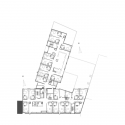
From the architect. The Advanced Engineering Building (AEB) at the University of Queensland is a state of the art engineering education building with flexible teaching and learning spaces.
The multi-purpose building has the appropriate mix of learning, workplace and social areas. The building co-locates five key materials, science and engineering research centres and occupies a prime site overlooking the University lakes.
Hands-on learning is embraced through an engaging and collaborative education environment. Some spaces follow a ‘design studio’ model with well considered learning tools that enhance the creative process.
The building integrates teaching and research laboratories in addition to large scale manufacturing and civil engineering research laboratories.
It supports various hydraulic, wind, materials and structural and advanced form processing laboratories within its program. The building also aims to act as a ‘live learning hub’ for students who occupy the building.
AEB facilitates new teaching and learning spaces that accommodate the University’s new curriculum. The building incorporates both passive and integrated sustainability initiatives with a targeted reduced energy consumption. HASSELL and Richard Kirk Architect in joint venture won the limited design competition for AEB.
If you have ever looked at a fantastic adventure or science fiction movie, or an amazingly complex and rich computer game, or a TV commercial where cars or gas pumps or biscuits behaved liked people and wondered, “How do they do that?”, then you’ve experienced the magic of 3D worlds generated by a computer.
3D in computers began as a way to represent automotive designs and illustrate the construction of molecules. 3D graphics use evolved to visualizations of simulated data and artistic representations of imaginary worlds.
In order to overcome the processing limitations of the computer, graphics had to exploit the characteristics of the eye and brain, and develop visual tricks to simulate realism. The goal is to create graphics images that will overcome the visual cues that cause disbelief and tell the viewer this is not real.
Thousands of people over thousands of years have developed the building blocks and made the discoveries in mathematics and science to make such 3D magic possible, and The History of Visual Magic in Computers is dedicated to all of them and tells a little of their story.
It traces the earliest understanding of 3D and then foundational mathematics to explain and construct 3D; from mechanical computers up to today’s tablets. Several of the amazing computer graphics algorithms and tricks came of periods where eruptions of new ideas and techniques seem to occur all at once. Applications emerged as the fundamentals of how to draw lines and create realistic images were better understood, leading to hardware 3D controllers that drive the display all the way to stereovision and virtual reality.
The replacement dwelling is set within an 18.5 acre plot, located adjacent to ancient woodland and heath, within the New Forest National Park. The massing, form and orientation of the new building has been carefully conceived in order that the proposals minimise the impact on the site and its surroundings. The main dwelling and guest building both have low rise green roofs. The buildings are orientated to maximise solar gain and utilise ground source heat pump technology and a log boiler for heating and hot water requirements. Excavated material from the new basement and pool area has been re-used in the earth-berming to provide a visual screen to the north and help to reduce the sound impact of the nearby dual carriageway. The proposals also incorporate rain water harvesting, grey water recycling and a natural swimming pond to further increase biodiversity within the site. The materials used throughout are sustainable, durable and in harmony with the site and its surroundings. The project received planning approval in 2007 and started on site in July 2008. Completion was achieved in September 2009. This project was awarded ‘Best Residential Project in the UK’ in the 2010 Daily Telegraph, Home Building & Renovating Awards, …
Performance: BREAM
Client: Notre Dame de Lourdes
Cost: € 6,800,000
From the architect. The project is located in the centre of Rennes and is composed of a home for the elderly, a children’s nursery and a restaurant with three levels underground parking.It also encompasses the existing “Notre Dame de Lourdes” clinic complex which is located on the north of the plot along the rue Saint Helier.
The use of empty space to structure and animate the project is a result of its functional requirements, urban context and site location.
The project is very much a part of its environment in terms of alignment, building height and rhythm while at the same time keeping a certain distance from same with its play on depth and transparency.
The principal south facing volume which gives onto the street has a double curtain wall façade which permits the use of climbing vegetation this in turn reduces the impact of natural light on the façade and also acts as a solution to privacy problems.The west side has a series of hanging planters that punctuate the façade and give the residents a green view.The style of the project takes its cues from the neighbouring buildings and has been inserted with care and attention. A treatment by shadow joint separates the façades old and new and this allows the alignment of the new parapet with the roof of the existing building.
An important focus of the operation was to form a therapeutic link for the Alzheimer’s patients with the exterior spaces. To achieve this goal the building is organized around a landscaped environment of an existing park, flower and vegetable gardens and the applied planting that brings life to the façades (planters and cables for climbing plants).
The use of colour in the interior spaces was an important way to highlight the different spaces and an aid to orientation for the Alzheimer’s patients.
The Shepaug River Valley Railroad, which ran along the Bantam River in the late 19th century, stopped at this location, once the site of a tiny local train depot. We saved and reinforced the existing 19th century rubble foundation, using it as the base for this new house. Two simple gable structures, oriented perpendicularly to each other, create space for a large open plan between them and refer, through their forms, to neighboring barns and to the region’s agricultural heritage. The house interior is lined with bleached pine; kitchen, dining, living and family rooms overlap each other and create a rich series of spatial experiences that accommodate relaxed weekend living. The living spaces open onto a lap pool which is edged in stone-lined gabion baskets and is surrounded by a cedar deck. Outdoor spaces provide views across the meadow to the Bantam River.
Smart city development has emerged a major issue over the past 5 years. Since the launch of IBM’s Smart Planet and CISCO’s Smart Cities and Communities programmes, their potential to deliver on global sustainable development targets have captured the public’s attention. However, despite this growing interest in the development of smart cities, little has as yet been published that either sets out the state-of-the-art, or which offers a less than subjective, arm’s length and dispassionate account of their potential contribution.
This book brings together cutting edge research and the findings from technical development projects from leading authorities within the field to capture the transition to smart cities. It explores what is understood about smart cities, playing particular attention on the governance, modelling and analysis of the transition that smart cities seek to represent. In paving the way for such a representation, the book begins to account for the social capital of smart communities and begins the task of modelling their embedded intelligence through an analysis of what the “embedded intelligence of smart cities” contributes to the sustainability of urban development.
This innovative book offers an interdisciplinary perspective and shall be of interest to researchers, policy analysts and technical experts involved in and responsible for the planning, development and design of smart cities. It will also be of particular value to final year undergraduate and postgraduate students interested in Geography, Architecture and Planning.
From the architect. The design for the new houses at No. 25-27 William St share a common platform, although these sites will form separate applications, they are conceived of as complimentary activities and are thus discussed together. The key ideas are expressed as follows.
1. The retention of the original “bach era” landscape.
The existing house at the beach at No 25 William St sits at the top of a lawn that is open to the Takapuna beachfront. This is now one of the few sections the opens so generously onto the public domain. This is seen as a positive gesture to the public space of the beach front and recalls an historic house type which is now rare in this region. This lawn or green space features a simple concrete path that extends to the beach from the house.
The intention is to retain and extend this green space and the axial path from the beach through to the William St address. This strategy involves opening the sites up to each other and linking them with a consistent landscape treatment.
There are two significant trees at each end of the combined site. These are to be retained as they are large scale plantings that will book mark the site. Similarly two traditional outbuildings are to remain at either end of the house on the front section.
2. Linking the buildings on the two sites.
An extended pathway from simple materials is to link the buildings on the two sites. The new buildings will be detailed to merge with the land form or , conversely, be strongly defined objects on the lawn and path. They are to be simply clad in robust, weathered hardwood panelling buildings with a concrete base. These materials are found from the existing “bach era” landscape as we’ll as the foreshore and neighbourhood.
The minor dwelling near William St at No.27 is to be clad in naturally weathering brass or copper metal panel it is intended to sit close to the retained large Puriri tree and form a detail on the site, a notional gate house or street elevation.
3. Respecting the local scale.
There are to be three discrete house forms. These have a combined plan area which is similar to the two existing dwellings to be removed.
The new from adjacent neighbours and occupies the approximately back third of it’s section. The House at No. 25 although significantly larger than the existing bach or cottage will be over 1200mm lower than the existing roof ridge. (At 8m wide it will be over 3m narrower when viewed from the beach than the existing house. It will however be 3m longer that the original house on the site. Relative to the neighbouring houses it is smaller in all dimensions from the neighbours either side.)
The house and minor dwelling at No. 27 are ancillary dwellings adjacent to the main house at No. 25. These are spaced at opposite diagonals on the site and appear as one room (5m) wide towers from the road. At their highest they are between 100-800mm higher than the existing house on the site but over a far smaller area.
The three houses will fit easily in the general pattern of the neighbourhood. They will rarely be seen all together and will appear as modestly scaled.
4. Packaging.
The new houses are notionally thought of as a small collection of containers or vessels. The content of these packages, set back behind robust claddings, are finely detailed and glazed.. The houses, or packages, have been placed and arranged so that the cladding conceals the content from the more public approaches and reveals the interiors as one accesses elevations that are interior to the site.
This subtle theme is developed further with the provision of folding and sliding able to be manipulated to suit the requirement of the inhabitants.
Building with brick is similar to walking. Placing one foot in front of the other eventually leads somewhere, just as putting one brick on top of the other ultimately leads to a built structure. Architects and builders have used brick as a building material for thousands of years. The modular simplicity and relative cost effectiveness are still appealing in contemporary architecture. Curved walls and sun shades, or brise soleil, are made possible with clever applications. Also unique to brick is the feeling that looking at a wall tells the story of the builder. Each brick placed and cemented by hand to form a useful whole brings a sense of craftsmanship to a building. Creativity and playfulness are rewarded in the presentation of this material, and even though it’s ancient, brick is still relevant to contemporary architecture. Here are projects inspired by and incorporating brick in fun and innovative ways. Meditation Pavilion by David Coleman Architecture, Montgomery, Alabama The small, modular nature of brick allows it to be plastic in its applications, as in the curved wall of this meditation pavilion. House on Mount Anville …
Is anyone more productive than Santa Claus and his elves? Mythically located at the North Pole, surrounded by fields of ice, the team magically fills handwritten orders, always hitting their deadline of Christmas Day. No one has actually seen inside this mysterious, miraculously industrious factory, but through secondhand accounts it is possible to piece together an idea of the ethos driving this workspace. Remarkably, Santa’s workshop reflects the concerns of contemporary industry: creating fun, open work environments that foster employee satisfaction and productivity all through collaboration. “Santa’s Workshop,” by Wilfred Jackson, 1932. Remarkably, many of Santa’s concerns mirror those of contemporary industry. It seems Google, Facebook, and every other company is racing to create the most fun, most open working environments. The hope of the businesses is that this typology will foster employee satisfaction, increase productivity, and create chances for collaboration leading to innovation. Facebook HQ by Studio O+A, Palo Alto, California When Facebook created their headquarters in Palo Alto, California, the management asked employees what they wanted to see. They came up with a design brief that incorporated three main things: sustainable and ecological design, a program …
Trainees: Joana Ramalhete, Nina Lucena
Ingeneer: Pirajá
Metalic Structure: D´angeli serviços de engenharia Projeto de instalações: Simon Merheb
Installations: Simon Merheb
Lightning: Joana Marcier
Site Area: 1,123 sqm
Providers: Pisoarte, Vidrospel, Trelicon, Telhas Tuper
From the architect. A house made for the granddaughter of great architect Sergio Bernardes and a Colombian artist was a challenge. At first they wanted the house to have characteristics of Casa Lota made by his grandfather in 1950, from which we kept some materials such as the ceiling. The development of the project was very interactive.
The house divides the field into two lengths, the skylight (24mx .60 m) is a feature that accentuates that division. This implementation was the beginning of the project. The primary objective was to preserve the centenary trees.
The vision goes beyond the house, the walls are glass. The parallel solid walls don´t interrupt the vision.
The living room is in the center, the rooms at the ends. The center of the house is a terrace when open. Brazilian homes all have a terrace as the most important place of socializing, in this case it is already one.
The roof, designed in 1.5 m beyond the glass wall offers protection in the main facades.What brings intimacy to that glasshouse is the immersion in nature. The light imprint the passage of the day on the parallel walls.The structure of steel was built in 15 days. The cover is of zinc-aluminum tiles, sandwich, was placed in one day.
The geography of the region, below the mountain and subject to flooding, were the reasons for the suspension of the floor at 80cm.
The Project is clearly a reference to Farnworsth´s house by Mies Van der Rohe with its calm presence in a site that should have remained untouched.