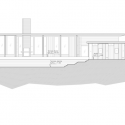
The pool shophouse in Singapore was designed by multi-disciplinary practice FARM and KD architects. The monolithic lap pool was inserted into the existing shophouse and guides the viewer from the front to the rear of the building. The additional parts of the house hover over the pool and are bathed in natural daylight from the roof.
With this monumental project for Zebrastraat in Ghent, Ervinck bundles some current topics and personal interests: the architectural discourse between blobs and boxes, the art historical motif of the veil and the social and political tension between public and private, and outside and inside. This monumental sculpture should be a meeting point that bridges the separation between public and private, and between inside and outside. Moreover, it elevates the “rear” of the building or neighbourhood to a visual attraction. Blobs and boxes This monumental sculpture is so to speak grafted on the building and illustrates the contrast between the conventional models of the architecture (box) and the virtual design (blob). It is a contrast between rigid and organic forms and between physical and virtual. While most architects favour only one single of these schools in design, Ervinck choose with this design resolutely for a third way: the synthesis of both. Inspired by architects like Will Alsop and Greg Lynn, Ervinck explored the potential of digital design methods for the sculpture. For Zebrastraat he designed an organic form that seems to loosen the cube, but at the same time can not exist without the latter. This tension between the solidity of …
The open office trend is rooted in some good ideas: encourage communication by breaking down barriers; give workers more space to breathe without confining cubicles. But a wave of new research is questioning the efficacy of the open strategy. A lack of acoustical privacy is chief among frustrated workers’ concerns—perhaps an anxiety related to the […]
Architects: ARX PORTUGAL Arquitectos
Location: Lisbon, Portugal
Architect In Charge: José Mateus, Nuno Mateus Design Team: Isabel Gorjão Henriques, Miguel Torres, Joana Pedro, Sofia Raposo, Rodrigo Gorjão Henriques, Paulo Rocha
Area: 436 sqm
Year: 2013
Photographs: FG + SG
Structures: SAFRE, Projectos e Estudos de Engenharia Lda.
Electrical And Telecomunications Planning Security Planning: Gabinete de Engenharia, Lda
Contractor: Manuel Mateus Frazão
From the architect. The concept for this house emerges from a reflection on the identity of Lisbon architecture, a recurring type of 6-meter-wide and 15-meter-long deep house, ending in a small garden in the back. It is a 5-storey building with two radically different elevations: one “public” in white lioz limestone (the most used in Lisbon) and the one in the back, in glass, connected by an interior world in exposed concrete, punctuated by birch wood elements.
The elevation obviously follows on the Lisbon tradition, stressed further by the windows’ rhythmic structure, opened in a span system created by horizontal strips and vertical bars – characteristic of the city architecture. Just as most of Lisbon’s old buildings, it is a flat elevation whose expressiveness comes from its rhythmic nature and the light-and-shade effects produced with the backing-up of its surfaces. This apparatus brings the elevation a sense of time, expressed by the change in the shadows throughout the day: from a more subtle morning light – with no direct sunlight – to the strong contrasting afternoon shadows.
Besides a straightforward concern in aligning the elevation with the surrounding lines, the design stresses an obvious contrast between the block-type bottom, and the more dematerialized crest. If on the one hand the ground floor responds defensively to the narrowness of the street, combined with the fact that neighbours park their cars in front of doors and windows, on the other hand the top comes out much lighter and dematerialized: it is a space at once interior and exterior – a top patio allowing the transition between the lower building, to the south, and the higher one, to the north. Nevertheless, despite its intimate nature, the space allows a view over the surrounding landscape and to the far-off Christ the King statue to the south, along the street line.
On the back elevation we have explored the extreme transparency which extends the interior onto the exterior and opens up the view to the garden – where a splendid Linden tree takes center stage – leading the eyes from the top floors over Lisbon’s hills, the Tagus river, and the South Bank. Radically opened to the exterior, the generous morning light that floods in directly is balanced by the gray concrete making up all the surfaces.
Inside, the precision of the design, as well as the inclusion of two doors in most rooms, endows the five small floors with a sense of a generous space, and give its dwellers a strong feeling of fluidity and freedom. The constructive research for this project provides an example in which the whole structure shapes the space and becomes architecture in itself: the whole concrete structure, built with only 3 planes – two gables and a transversal plan – is set forth and designed to define the essential house space.
At once a natural and staged space, of both contemplation and living experience, the garden is expressed as an archeological site, where all layers of time, since the house was built, are present. Here, one can still see the ancient techniques that have raised thick stone walls (often recovered from other buildings), later brick overlays, mortar or paint, as well as the stones from the demolished house that have become pavement.
Architects: Dörr + Schmidt
Location: Panquehue, Valparaíso Region, Chile
Architect In Charge: Manuel Dörr, Pablo Schmidt
Area: 662 sqm
Project Year: 2013
Photographs: Marcos Zegers
From the architect. The project is located in the base of the range that surrounds the Aconcagua Valley in a 10 acres park, surrounded by avocado trees plantations and is tied to the ground by three walls of concrete that opens to the plain. The house lies between these walls generating a series of patios that graduate the space from the interior of the house to the valley. This manner of graduating the space between interior and exterior is inspired in the old colonial houses of the Aconcagua valley.
Also rescue the pureness of lines and horizontality of the patrimonial houses of the valley together with the rhythm produced by the repetition of volumes and pillars .
The house was built mainly using recycled woods except for the cover of the interior walls where pine tree planks was used. The pillars of the house originally was part of the structure of tunnels of the old train that crossed Los Andes Mountains from Santiago, Chile to the Argentinian city of Mendoza.
Getting instantaneous, accurate structural dimensions in the early stages of the design process, or even when exploring the feasibility of a project, can often be challenging. In response to this, Vancouver-based structural engineering firm Fast + Epp have developed a new mobile application called Concept, a depth calculator which uses typical span-to-depth ratios for common steel, concrete and wood members to give you a quick overview of what dimensions a certain structural idea will require. In addition to this, the app also includes project photos to give users an idea of how certain materials will be expressed in built form.
According to Fast + Epp, “the user simply indicates if the information they’re inputting is a roof or floor, with the internal calculator determining an approximate depth. Additional information is provided to qualify the load assumptions and tributary areas. Users are able to share search and calculation results by emailing them to co-workers and clients for discussion prior to the first design charrette”.
The app is clear and functional, providing architects and engineers with a unique facet to their mobile device. It’s a useful starting point for any designer who wants to test their structural ideas.
You can download the free app from the iOS App Store. According to their website, an Android compatible version is anticipated soon. You can use the app in either metric or imperial dimensions.
Architects: Taller Diez 05
Location: Boca del Río, Veracruz, Mexico
Architect In Charge: Manuel Herrera Gil
Collaborators: Luis Enrique Alvarez, Eder Ferreira, Francisco Dorado
Area: 55 sqm
Year: 2013
Photographs: Luis Gordoa
From the architect. Located in the south of Veracruz City in Mexico, the Pavilion – S is an annex of an existing dwelling house that has the intention to accommodate different complementary uses as a multifunctional space.
In terms of design, the architectural concept is originated from the idea of INSERTION to an existing contained space with typological and natural default conditions.
As this was an established consolidated dwelling, there were certain typology aspects to put onto consideration that established the environmental space from the site such as: vertical apertures, flares, lattices and historical reminiscences of San Juan de Ulúa historic fortress, that were the starting point to analyze the main signs to shaped permanently this project.
While being compromised by a magnificent existing green area, the strategy changed on making minimal contact with the adjacencies and fully structured vegetation elements, taking advantage of the natural views to the immediate environment.
At the same time this intervention was located in an area of the property that allowed the visibility of an existing green wall, that is why the overall idea was creating a block that compresses the interior program through a “Spatial Bond or Belt”, releasing its longitudinal fronts, where the view from the dwelling is predominant.
To formally define the building, the Pavilion is connected to the existing building trough a wood box connector as a link between these two elements; there is a concrete wall framing the living room area where gently gets involved with a narrow zone of vegetation.
In 2007, Zaha Hadid Architects won a competition to design an Innovation Tower for Hong Kong Polytechnic University. Six years later, students and faculty are beginning to settle into the glacial, 130,000 square foot, 250 foot tall design-education center as it nears completion. The space-age, striated structure will be a “creative multidisciplinary environment,” that, according […]