The house was designed around a light touch, on the site, and on the environment. A home was created for a growing family, a place to retreat to and a place to enjoy both the family and the surrounds.
[ccw-atrib-link]
The house was designed around a light touch, on the site, and on the environment. A home was created for a growing family, a place to retreat to and a place to enjoy both the family and the surrounds.
[ccw-atrib-link]
The recent 2014 Tribeca Film Festival screened a remarkable number of films on displacement. People were displaced from their homes—often forced but sometimes voluntary—for financial reasons, discrimination, landlord harassment (or irritation), and natural disasters. In the film Below Dreams, which takes place in New Orleans, a character says “Everybody needs a room.” Here are a […]
[ccw-atrib-link]
Bohlin Cywinsky Jackson and Eckersley O’Callagha, both longstanding collaborators of Apple’s flagship stores, has been commissioned to transform a 93-year-old former United States Mortgage and Trust Company building on Madison Avenue into the chain’s next New York City store. Though little has been released about the design, the store’s grand opening is planned for 2015. More information can be found here.
Apple Taps Bohlin Cywinsky Jackson to Revamp Historic NYC Building originally appeared on ArchDaily, the most visited architecture website on 20 May 2014.
send to Twitter | Share on Facebook | What do you think about this?
[ccw-atrib-link]
As we continue to congregate in increasingly urban, built-up, and densely populated areas, looking up at the sky has almost become a forgotten luxury. (When’s the last time you watched the sun set?) Bright city lights and pollution make it nearly impossible to see any sort of cosmic matter with the naked eye. To prevent the “big dipper” from becoming something we’ve only read about, a sort of mythical constellation, it is essential to take back our environmental awareness, and, perhaps, the pastime of stargazing — and you don’t have to leave the comforts of your big city to do it. Recently, Cardin Ramirez Julien + Ædifica teamed up to design Rio Tinto Alcan Planetarium in Montréal, Canada’s second largest city. The site creates a trifecta of well-connected (physically and visually) cultural establishments — the Biodome, Olympic Stadium, and planetarium. Functionality and use rely heavily on the visitors and their desire to connect the experience of stargazing with the act of being in nature as a whole, ultimately creating a public space that serves as an escape within the city that patrons can call their own. Of course, this isn’t the only celestial viewing spot implanted into an urban space …
[ccw-atrib-link]
The architects of NRJA have been chosen to curate Latvia’s participation at the 2014 Venice Architecture Biennale. Based on the assertion that “there is (no) modernism in Lativa,” the pavilion’s exhibition Unwritten will confront the lack of research and evaluation of Lativan post-war modernist architecture.
As the curators describe, the insufficient acknowledgment of Lativan post-war modernist architecture is the result of a tricky situation. On one hand, “there is an aversion to anything that occurred during the period of Soviet occupation,” while on the other “there is wave of uncritical nostalgia for the country’s youth and childhood, as well as the superficial hipster joy at the exotic Soviet heritage.”
Though many of these structures would have already achieved “monument” status in other countries, there has been no evaluation of their importance to Latvia’s architectural heritage. At the threat of demolition, these post-war buildings risk never being researched, leaving a period of Latvia’s architectural history unrecorded.

Thus the curators of Unwritten plan to highlight the modernism in Lativa and spark a global discussion that will hopefully result in the largest-ever database for post-war Latvian modernist architecture.
Join the discussion, here.


Venice Biennale 2014: NRJA to Establish First-Ever Database of Latvian Post-War Modernist Architecture originally appeared on ArchDaily, the most visited architecture website on 15 May 2014.
send to Twitter | Share on Facebook | What do you think about this?
[ccw-atrib-link]
Studio Gang’s first New York City tower appears to be moving forward, albeit a little shorter than originally envisioned. Initial plans called for a 213-foot tall, 180,000-square-foot office tower—known as the “Solar Carve”—that would have been 34% larger than what is currently allowed on the site. After it became clear that wasn’t going to […]
[ccw-atrib-link]
By tattooing walls, graffiti writers free them architecture and turn them once again into living, social matter, into the moving body of the city before it has been banned with functions and institutions.
When Architects Build Brands: Is Architecture’s Future in Advertising? | Meet the Dynamic Duo Behind Architecture Firm Fuksas | Why Architects should Blog | The Green Building Reality: Why Two-Thirds of the Profession Are Cowards | One of America’s Most Famous Architects Was a Nazi Propagandist | A beautiful mobile home for just $33,000? | A degree in architecture … but all I can get are menial jobs
last word: 2014 – End of Year Exhibition at the Caribbean School of Architecture
[ccw-atrib-link]
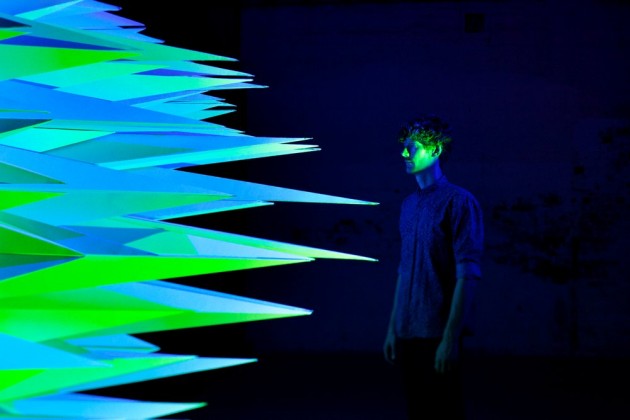
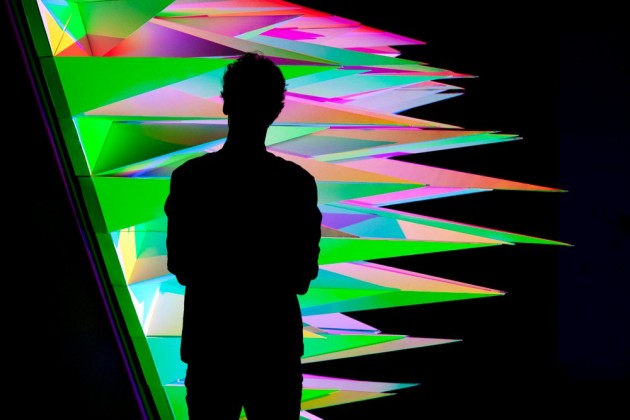
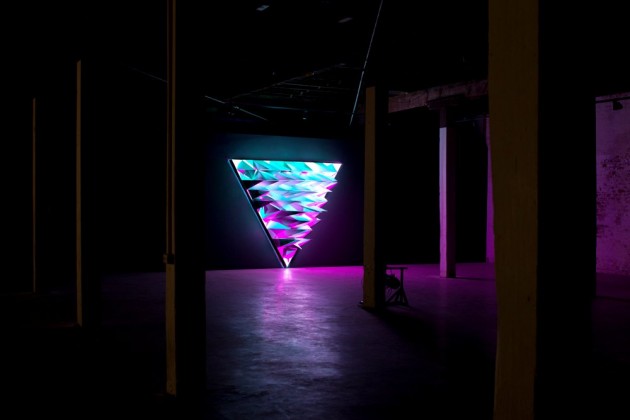
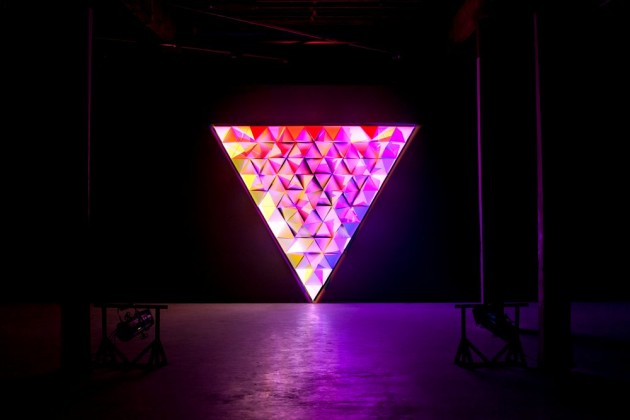
Flynn Talbot has created a lighting installation named Primary, that was recently shown at PSAS in Perth, Australia.
You can watch a video of Primary – here
From Flynn Talbot
A new exploration in colour and light. Primary is a three sided wall installation which is illuminated by three LED light sources. This is a reference to the primary colours of light, red, green and blue (RGB). These base colours of light have defined the quantity of light sources and the use of triangles. Everything in threes. The cardboard structure is designed to fragment the light and show how coloured light is mixed. Light and object are intrinsically connected.
This is a concept which has been scaled to suit the available space and can fit in many interiors. Visitors to the exhibition were presented with a long view of the piece, most thinking it was simply a 2D projection on the wall. On a closer look the 3 dimensionality of the work became apparent and the depth of the polygons (up to 2 meters) could be seen. The front and side view are very different, each offering a unique visual experience.
Primary has been specifically designed to create the right ratio of shadow which is then illuminated by the opposing light sources. Light and shadow are working together and through a 10 minute programmed light show, a real feeling of movement is created. A beautiful landscape of fragmented light that looks impressive on its own but very powerful with the perfectly shaped light. A soundscape completed the installation for a full immersive experience.
Primary was conceived when I lived and worked in Berlin. Almost 2 years later I found a temporary home for it in my home town of Perth, Australia. After many experiments with different light sources and cardboard structures I found a balance of dark and light to create a deeply moving installation.
The most exciting thing about working with new technologies in lighting is that this project really wasn’t possible a few years ago. Only recently has a single source colour changing LED module been powerful enough to illuminate a work of this scale. In the past it would have had to be illuminated with a metal halide light source and an old rotating colour wheel. Now I can truly create my vision of pure saturated colour that smoothly shifts through a programmed spectrum.
This installation is supported by Philips Selecon
Artist: Flynn Talbot Studio
Photos © John Madden
Film and soundtrack © Flynn Talbot Studio
[ccw-atrib-link]
Architects: Tamás Nagy
Location: Gödöllő, Hungary
Area: 1,340 sqm
Year: 2007
Photographs: József Hajdú


Collaborators: Tamás Lévai, Ildikó Bujdosó, Anna Meditz

From the architect. The three elements of the building – the church, the parish and the community house – surround a regular quadrat-shaped courtyard. The courtyard will be soon a garden with trees and flowers and with a fountain in the middle. As long ago in the monasteries.

Because the model comes from there. The difference is that this courtyard is opened in its fourth side – it is bordered only by a tracery fence – and this is an important message to the World: come in, we are open. If once the park is finished as well, the water of the fountain will flow as a vein to there and swell into a lake. This movement strengthens the previous idea: the connection between inside and outside is relevant.

The system of the service seems emblematic: the glassed corridors lead along the courtyard and broaden to a forefront in front of the community area. The certain functions as the resident and office part of the parish, the rooms of the community house and the space of the church are strung into this „U” shaped system.

The central space of the church is oriented to the apse. As the three building wings surround the courtyard, so the „U”-shaped gallery does surround the apse, the main central point of the building. The apse, the only arc in the house differs not only by its form from the other elements, but by its colour as well.

The 63 colour glass window contain a hidden message. As the result of the dutch componist Alexander Skrjabin’s research he created a matrix, in which every single note matches to a single colour. Applied this note-colour code I wrote the gregorian tune of our prayer Kyrie eleison to the windows of the arc wall. It is a non-designed surprise that the colour glass windows are even burning when the sun does not shine outside.

The colour world of the church – perhaps too pure and strange for some – is to strengthen this exaltation. Depending on the time of the day the space of the church is swimming in light stream or dawning in dusk, but the place of the eucharisty remains at the centre of our attention.

The chapel next to the church is purposely simpler, with its transparent windows I tried to support one’s inside-turning. It will be hopefully a space of the calm prayer. And at the end about the tower. Building a church without a tower was stylish in the modern sacral architecture of the 20th century. I think the church should be a sign at the beginning of the 21st century in Hungary, in Europe, where the evangelism seems to be needed. I hope that the seven-storeyed tower of the Roman Catholic Church of Gödöll will be the symbol of the presence.


Roman Catolic Church / Tamás Nagy originally appeared on ArchDaily, the most visited architecture website on 10 May 2014.
send to Twitter | Share on Facebook | What do you think about this?
[ccw-atrib-link]
My Florence: Photographs by Art Shay Museum of Contemporary Photography 624 South Michigan Avenue Chicago, IL Through May 24 My Florence is a photographic project by renowned Chicago Photojournalist Art Shay. For over six decades, Art Shay’s photographs have appeared in such periodicals as Time, Life, Fortune, and Sports Illustrated. In Shay’s words, My Florence […]
[ccw-atrib-link]
