Within the framework of our project, architecture and art are found side by side, are entangled, extend and complete each other in order to create a common language, a synergy which creates an intriguing, vivid and dynamic, yet at the same time intimate, welcoming and friendly ensemble. The reflection on the relation between art and architecture is part of the concept created with the involvement of the Luxembourgish artist SUMO. It is a response linked to the evolution of the urban landscape because the era of the “post-graffiti”, even if many refuse to admit, has become an integral part of the city. Sumo voluntarily covered the space from the ground to the ceiling with his artwork in such a way that his art, which one can consider being “post-graffiti”, is subtly integrated in the built space. Architecture gave way to art which reveals itself at times under the overhanged volumes with yellow, orange and red clouds, at times in the background of the loggias of the apartments with its peculiar figures. Art emphasizes this formal game of the spaces that seem to have “slid” to give way to the organic sketches and eccentric colors created by the artist. This cooperation …
Louisville Mayor Greg Fischer started 2014 off with a call to citizens: Help the city come up with creative ideas to redevelop vacant land. Local and far-flung designers are invited to re-imagine the land in a new competition. The winners of the Lots of Possibility competition will be awarded a total of $38,000 to put their […]
Mass- production is the realm of the industrial designer and the process engineer – so let them maintain claim over that territory. The bespoke is the true specialty of the architect and the contemporary profession has more facility than ever to implement difference in the most intelligent of ways.
The blog wunderlust is a weekly round up summarizing the architectural highlights, news and web links, that don’t otherwise fit the format of this blog. If you have any to share feel free to drop me an email
Designed by New Orleans based practice Trahan Architects, the 64,000 ft2 Baton Rouge Municipal Dock lies on an emerging pedestrian thoroughfare that connects Louisiana State University with downtown area and the Mississippi River. At a cost of $20 million, the mixed-use development will allow residents and visitors a host of public facilities under the backdrop of the river.
Architects: Manuel Cucurell, Sebastián Virasoro
Location: Roldán, Santa Fe Province, Argentina
Project Team: Guillermina Borgognone, Ciro Rádice, Florencia Rinaldi, Germán Rodriguez.
Construction: Gustavo Farias
Exterior Furniture: Silvestre Borgatello-Estudio Loess
Project Area: 139.0 m2
Project Year: 2013
Photography: Gustavo Frittegotto, Manuel Cucurell
From the architect. This project is located in an area of the emerging farm pampa in a process of transformation, product of the economic growth in Argentina in recent years and the illusion of leaving the chaos of the city.
There, a new urban development seems to replicate a predominant scheme of soil use and productivity: an imperative of rationality of loads and maximum benefits in the yield of the land.
These are developments that have displaced crops leading to neighborhoods without public space. There are no sidewalks with trees and shadows, only internal roads and minimal services. Paradoxically, these areas in the Argentine plains seem to edit a colonization of the pampa. More than a century ago, through the railway stations, the immensity of the plains were inhabited. In these colonies, the new settlers had to face the empty immensity, the fear of darkness, and the distance at night.
This scene is repeated today, but not long from now, these areas will end up consolidated, setting up a new event: the privacy of the inhabitants will be invaded by the inability to build party walls and by the density with which these neighborhoods are designed.
Cisura House
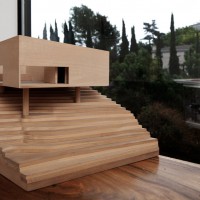
How to conceive a spatial structure that beyond housing the activities required, is able to respond to the contingencies of a scenario and people in transition? A structure that can meet the need for protection and shelter at first, and over time, transmute into privacy.
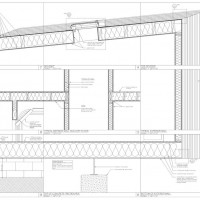
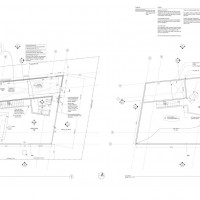
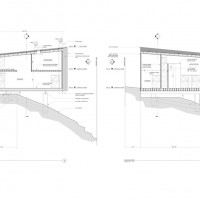
“In response to these concerns, introspection is the argument that guides and sets the search criteria.” The fissure, both concept and action, is a gesture that gives the project its expressive character, bringing in light and determining different spatialities where inside and outside are expressed as ambiguous and indistinct concepts.
Introspective and anonymous atmospheric experiences are possible by designing small courtyards within the interior spatiality, which opens even the possibility of experiencing showering under a summer rain.
The house is therefore conceived as an open system, an ordered set of elements and associated factors that interact with each other. Each of the parts has a specific function, which integrated and dependent on each other keep the whole operating.
The coherence of the project as unit arises from the symbiosis between the factors of the system, those of the environment in transition, and those of the complex web of emotions that belong to all of human creation.
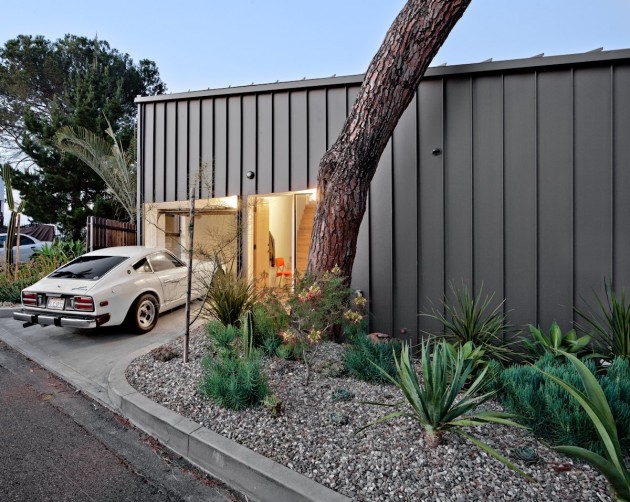
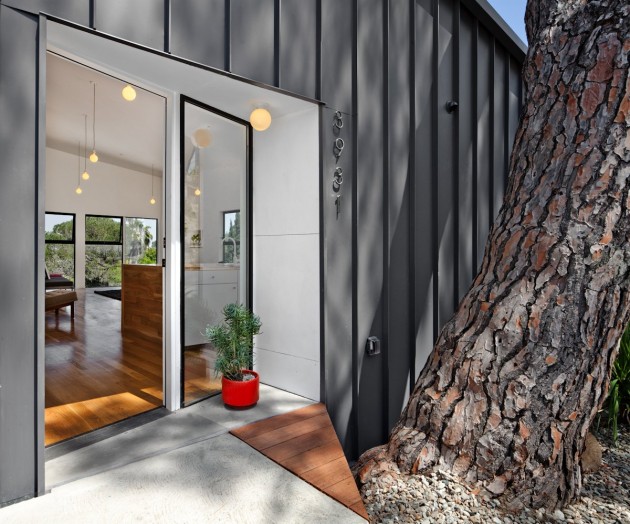
Anonymous Architects have designed the BIG & small House in Los Angeles, California.
Project description
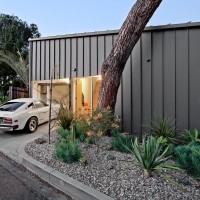
Starting with a vacant lot that was half of the typical minimum lot size, the objective was to compensate for the relatively small footprint of the house.
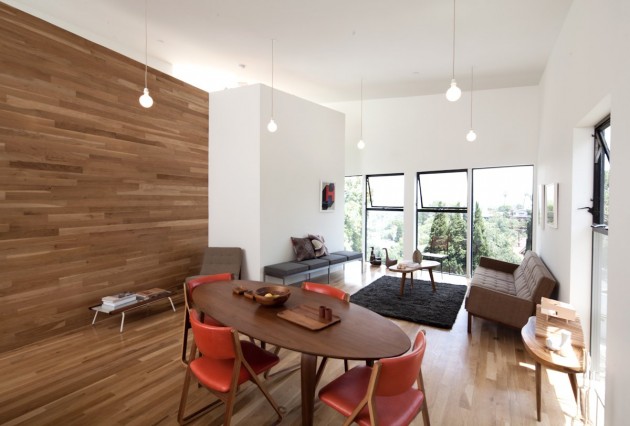
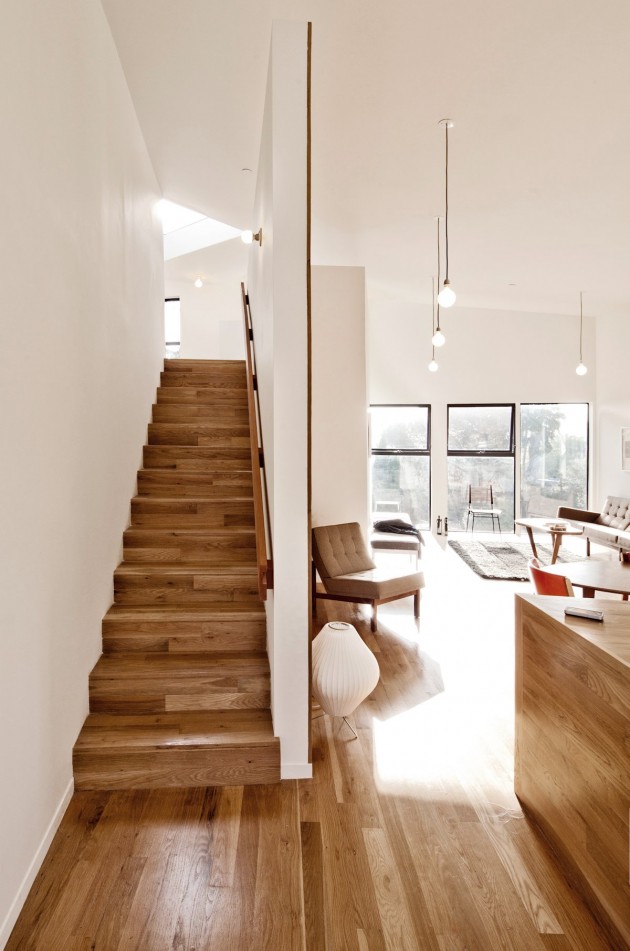
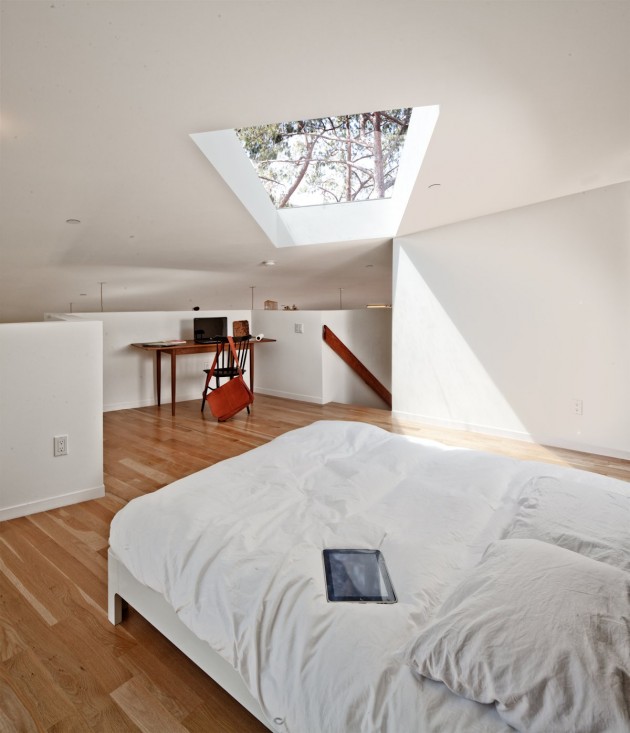
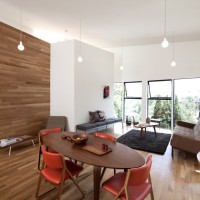
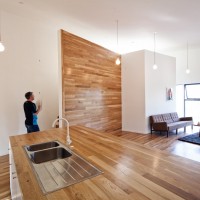
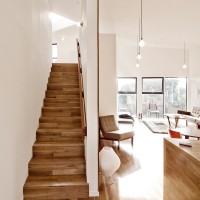
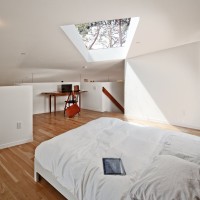
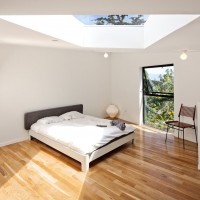
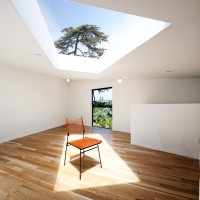
To achieve this there are only 2 full height walls inside the house which makes the main interior room nearly as large as the building footprint. This gives the house an open lofted feeling with very high ceilings and abundant natural light.
It is an inversion of expectation, so that the smallest house contains the largest room. What the house lacks in square footage it provides in volume.
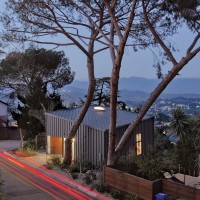
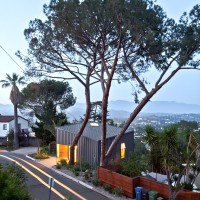
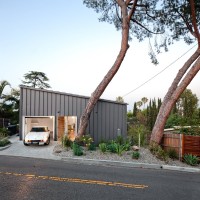
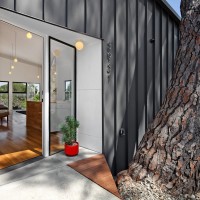
The free plan of the vacant lot is preserved since the house touches the ground only at the four small piles, giving full access to use the space between the house and the lot. The footprint of the foundation is in fact less than 20 sq.ft. and the house doesn’t touch the ground at any point.
The plan of the house follows the shape of the site which is an asymmetric parallelogram. This form resulted in unusual geometry inside and outside the dwelling and explains the shape of the house. The elevations of the house are designed to mirror the plan.
The 361° Conference, an initiative by Indian Architect & Builder to create a relevant platform for dialogue on architecture in India, will take place on February 19th to the 21st in Mumbai. This year’s edition, based on the theme of “Architecture and Identity,” will include renowned speakers, including Steven Holl and Dr. B V Doshi. More details, after the break…
Conference Description
One of the oldest design forums in India, the 361° Conference is an initiative by Indian Architect & Builder (IA&B) to inspire a thought-exchange programme on relevant ideas in architecture and critical concerns of the discipline and thus, create a relevant and serious platform for dialogue on architecture in India.
The seventh edition of the 361° Conference is scheduled for the 19th-21st February 2014 at the Nehru Centre, Mumbai. This edition will deliberate on the theme ‘Architecture and Identity’. In the context of architecture, as we move further in the 21st century, we find incredibly diverse and individual trajectories of academia, practice and building. Within this diversity, we find a consistent struggle by individuals and groups to anchor ideas to their appropriate roots. Introspective and reflective in its essence, this search for the origins or the fundamentals is critical in contemporary architecture as the search is what determines the trajectory. This Conference will focus on the people and practices that have an investment in the idea of identity; whose work takes a critical position on this issue.
Speakers
DrB V Doshi, India; Steven Holl, USA; William J R Curtis, France; Aniket Bhagwat, India; SPASM, India; Channa Daswatte, Sri Lanka; Dominic Sansoni, Sri Lanka; Minakshi Jain, India; Rick Joy, USA; Hector Fernandez Elorza, Spain; Lars Müller, Switzerland; and Kashef Mahboob Chowdhury, Bangladesh; Atelier Vylder Vinck Taillieu, Belgium; Carin Smuts, South Africa & Emre Arolat, Turkey.
Architects: 2b architectes, nb.arch
Location: Corpataux-Magnedens, Switzerland
Design Team 2b Architectes: Stephanie Bender, Philippe Béboux
Design Team Nb.Arch: Sarah Nedi, Luc Bovard
Year: 2007
Photographs: Thomas Jantscher
Collaborators: Corina Ebeling, Gudrun Warnking, Stéphane Schers, Yves Macherel
Construction Management: Ruffieux-Chehab Architectes SA
Civil Engineer : EDMS ingénieurs, Nicolas Senggen
Landscape: Michèle Robin
Client: Commune de Corpataux-Magnedens
From the architect. The impression made by the new council offices building in Corpataux is both fascinating and irritating at the same time. On the one hand it has the almost archetypically simple form of a house with a pitched roof, while on the other it is ennobled through its envelope consisting of a carefully staggered tuff incrustation.
The stone used here brings to mind an old tuff quarry nearby and thus also recalls the history of the village. Through its intelligent positioning this public building creates a new square in the village. The simple external appearance with a calm sequence of windows is reflected in the interior in the clear and functional organisation of the different spaces: a circulation zone, offices for the local administration and a large multi-purpose room on the ground floor; cloakrooms and meeting rooms for local associations at basement level.
A clever use of the contrast between light and dark distinguishes the circulation zone from the main hall. The hall is also the “pièce de résistance” of the building. The concept of a building within a building strengthens the impression made by this pleasant and autonomous space. Its dark lined walls are given life by a dense sequence of projecting timber louvers that extend in a linear fashion from the floor to the internal outline of the pitched roof. In general this building manoeuvres its way between the everyday and the extraordinary and is particularly fascinating because here the normal is formulated in a special way, both internally and externally.
Diller, Scofidio + Renfro announced today that their reorganization of the Museum of Modern Art will include the replacement of Tod Williams and Billie Tsien’s former American Folk Art Museum at 45 West 53rd street. Liz Diller said in her briefing that DS+R hoped to save the Folk Art building and repurpose it into a […]
From the architect. The theme of this house is air volume. This house has many layered air volume.
So I call this house “polyphonic”. The site is a place used to be a workplace of the construction company and it seems atmosphere savage. It is not feel the context of orientation, so I put the house on the center of the site to be no hierarchy around the house.
This house changes the air volume between summer and winter. The aim of the nesting composition in section and plan is to change the air volume. This principle is similar to the principle of Japanese traditional “Kotasu”. To reduce energy consumption by controlling of air volume, it makes comfortable interior environment. I think there is very few architecture to achieve environmental control and good space at the same time.
I think this thinking works in subtropical region as well as in cold area. This method of construction is good way to be able to cope with various environments. I think this method is primitive way.Many other past projects are related to this project. For example “Layered House”, “Ordos 100” and “House of Eden” are closed to this project.
Past projects is strong thinking to interior. This house may also seems to be strong.