Parkzone created this 3S 11.1V 1300mAh LiPo battery for those park-flying enthusiasts looking to pack some serious punch into their R/C airplane. This ParkZone LiPo includes the new style EC3 connector as well as a standard balancing plug.
2013 Red Hat Summit OpenStack Architecture ~ Redhat Linux Video Subcribe Us : http://www.youtube.com/subscription_center?add_user=RedhatLinuxVideo linux serv…
Architecture jobs. http://www.AdaptAndThrive.net Architecture jobs are in rapid decline. Jobs for architects probably won’t completely disappear. There will …
http://42d60hv8czjy4u7dsfwrkjwzdo.hop.clickbank.net/ We have designed the most popular RC jets in the world! That means the most popular build methods in the…
Whether a gently rolling hill or rocky steep terrain, a sloped site provides a compelling setting on which to build a house that contrasts with ordinary flat lots. Unlike horizontal typography, where every structure lies at the same elevation, a slope allows for the rooflines of houses to stagger down the site, providing more expansive, uninterrupted viewpoints. But while a steep site comes with the advantage of panoramic vistas, it also presents challenges to architects. Since houses usually sit perpendicular to the site, architects must design the foundation to properly mitigate the angle of incline. The steeper the angle, the taller the foundation — which can sometimes lead to houses that look as if they’re propped up on a pedestal. Alternatively, the lower levels of houses can be dug into the land, which leaves half of the living spaces sitting below ground. Today, we see architects coming up with innovative solutions to building on slopes — such as designing structures that physically mimic the angle of incline. The following designs for sloped sites are anything but slippery: 8008 by Hiroyuki Arima, Fukuoka, Japan On a steep slope in Fukuoka, Japan, the 8008 house is composed of …
Model diesels are generally 2 stroke engines that intake a fuel air mixture, compress that mixture on the upstroke and when the temperature of compressed mixture reaches the ignition temperature of the constituent with the lowest auto ignition temperature, combustion occurs which usually is the Either. This critical component is not the easiest to obtain and in some countries is actually a controller substance. This book shows how to make your own mix of model diesel fuel.
Every day, all over the world, animals and insects set about the purposeful tasks of designing their homes, catching their prey, and attracting their mates. In the process they create gorgeous nests, shelters, and habitats. Capturing 120 of these wonders in all their beauty and complexity, Animal Architecture presents a visually arresting tribute to the intersection of nature, science, function, and design. Ingo Arndt’s stunning studio photographs and vibrant in-situ shots of nests, forests, and wetlands provide close-up details of these designs, as well as the animals who created them. These compelling images are combined with an abundance of fascinating facts about the evolution of animals and insects, as well as their survival methods, mating habits, genetic dispositions, and more.
Interior Design: NC Design & Architecture
Design Team: Nelson Chow, Chris Lam, Yazh Yip, Pierre Wu
Furniture Designer: Bridge Lam
Contractor: Kin Wah Decoration Limited
Custom Lighting Supplier: Ricardo Lighting Limited
From the architect. Prominently located on the 10th floor of the Times Square Shopping Center in Causeway Bay, Hong Kong, Pak Loh Chiu Chow Restaurant by NCDA is the latest addition to the multi-outpost Family owned Restaurant Group. Established in 1967, Pak Loh is locally renowned for its traditional Chiu Chow cuisine, which originates from the coastal region of Guangdong Province. To cater to the evolving tastes of the newest generation of Hong Kong diners, Pak Loh’s mission is to bring new elements to popular conventional dishes using innovative techniques and premium seasonal ingredients. As a design strategy, NCDA interpreted the mission statement and created a 6000 SF restaurant that represents the convergence of the old and the new through a synthesis of vintage references and streamlined modern details.
Arriving at the restaurant, diners pass through a curved passageway comprised of faceted brass vertical screens which leads to the main wood covered dining room. Placed on either side of the entrance, two curvilinear VIP rooms allow for a gradual passage from the bustling mall into the cocoon like wood interior of the main dining space. The compressed entryway accentuates the generous volume of the main dining room beyond, and in turn the transition provides a calm yet discreet experience for the patrons as they enter and leave the restaurant.
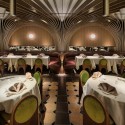
Dominating the main dining room, the vaulted walnut veneer ceiling structure references the spirit of 1960’s Hong Kong in a futuristic cutting-edge manner. The ribbed CNC milled ceiling structure consists of 20 half arches, which are rotated and repeated at angular increments to cover the entire ceiling. The ceiling geometry results in a cost effective and relatively simple installation that yields a unique and complex form. The wood clad structure offers good sound absorption properties which helps to reduce noise level in an otherwise loud space. Bespoke wall sconces and suspended light fixtures are being placed strategically to create a rythmical pattern that further highlights the delicate framework of the ribbed structure.
While the vaulted structure of the main dining room appears airy and larger than life, attention to small details and materials offer a comfortable and intimate scale at each of the dining zones. For instance, custom upholstered burgundy leather banquettes with horizontal mirrors and 60’s geometric print wallpaper define individual table groupings. Furthermore, custom olive green velour chairs with curved legs are design to echo the vaulted ceiling and to break the scale of the space down to more intimate components.
Efficiently located at the back of the restaurant, the bathroom is divided into male and female halves using a large central communal sink. Custom backlit male and female WC indicators are placed above each door in the manner of an aircraft installation, and leads the patrons to the corresponding toilet compartment where each one is cladded with a distinct color tiles.
In the design of Pak Loh, NCDA sought to avoid any direct links to the Chinese vernacular, while mixing modern and classic materials to create a comfortable and refined dining space that respects the 60’s Hong Kong manner of dining. Pah Lok Chiu Chow Restaurant showcases a holistic approach to restaurant design, seamlessly integrating the interior design, furniture, lighting fixtures, graphics, and staff uniforms. By defining an aesthetic from the mood and lighting of a space right down to its detailed ceiling construction, the end result is a visually striking yet highly functional contemporary restaurant.